
What makes a nail drill bit factory consistent in large production runs
What makes a nail drill bit factory consistent in large production runs
When people evaluate a Nail Drill Bit Factory for large production runs, the real question is not whether the factory can make a lot of pieces. It is whether the 10,000th bit behaves like the 100th bit, with the same cut quality, balance, durability, and packaging condition. In practice, consistency comes from four things working together: stable raw materials, controlled production parameters, traceable inspection, and packing standards that protect the product after it leaves the line. If one of these is weak, volume only makes the problem larger.
A quick answer is this: a factory stays consistent in large runs when it can control variation, not just increase speed. That means every batch is built on the same input quality, checked against the same criteria, and released only when records support the result.
Many buyers focus first on output capacity. That matters, but it is rarely the point that causes trouble later. More often, the problems show up as uneven grit bonding, shank diameter drift, burrs, poor concentricity, mixed batches, or packaging that allows damage during transport. These are not “small factory errors” or “big factory errors.” They are control errors. A factory can be large and still be unstable. It can also be highly dependable if its process discipline is mature.
What consistency really means in a nail drill bit production environment
In this category, consistency is not limited to appearance. Two bits may look similar in a carton and still perform very differently in use. For abrasive nail bits, practical consistency usually includes:
- Uniform abrasive performance from batch to batch
- Stable dimensions, especially shank tolerance and working head geometry
- Reliable bonding strength so the abrasive layer does not fail early
- Controlled surface finish without unexpected rough points
- Predictable balance and rotation behavior at working speed
- Clean labeling and packaging traceability
For inspection and safety teams, this matters because variation at the factory level becomes field risk very quickly. A bit that is slightly off-center or poorly bonded may still pass a casual visual check, yet create heat, vibration, shortened service life, or user complaints later. In other words, factory consistency is not an abstract quality goal. It is a direct control point for product safety and complaint prevention.
Raw material stability is where most consistency problems start
A lot of people assume finished-product inspection is enough. It is not. If incoming materials vary too much, the factory ends up sorting defects after value has already been added. That is expensive and unreliable.
For a nail drill bit factory, the exact raw material set depends on the bit type, but the control logic is similar: abrasive grain quality, bonding material stability, metal substrate or shank tolerance, and plating or finishing inputs must be qualified before production begins. If the abrasive particle size distribution is drifting, the cutting feel will drift. If the metal base is inconsistent, the finished bit may have balance or fit issues. If bonding or plating inputs vary, service life can become unpredictable.
This is one of the easiest areas for buyers to underestimate. A factory may show clean final inspection reports while still managing unstable inputs through heavy rework or sorting. That is not the same as a stable process. A stronger sign is whether incoming material controls are documented, repeatable, and tied to supplier performance.
In real sourcing discussions, it is worth asking simple but revealing questions: Are raw materials approved by lot? Are nonconforming lots isolated? Are there records linking each production batch to material lots? If the answer is vague, consistency risk is usually higher than the quotation suggests.
Process discipline matters more than impressive machinery
Equipment matters, but consistent output depends more on whether key process conditions are locked down and followed. In abrasive product manufacturing, small shifts in speed, pressure, curing conditions, grinding steps, or plating time can change the final result in ways that are not obvious at first glance.
That is why mature factories pay close attention to process windows. They know which variables are critical, what range is acceptable, and what action is required when a reading moves out of range. This sounds basic, but many production issues come from informal adjustments made by experienced operators without a formal record. Skilled people are valuable, but a process should not depend on memory alone if the run is large and repeatability is the goal.
One common mistake is treating all large orders as a scheduling challenge. They are also a change-control challenge. Once production scales up, tool wear, shift handover differences, machine maintenance timing, and operator substitution can all introduce drift. A factory that stays consistent usually has written process standards, in-process checks at fixed intervals, and clear hold points before the next stage starts.
That is also where safety thinking overlaps with quality thinking. A process that drifts silently is harder to detect before product reaches the user. A process with defined limits and mandatory checks is easier to audit and easier to trust.
Inspection must be traceable, not just frequent
Some factories talk a lot about “100% inspection.” That sounds reassuring, but by itself it does not prove much. In many light industrial products, inspection quality depends less on the slogan and more on the method: what is checked, how often, against which standard, by whom, and with what disposition rules.
For large production runs, traceability is what separates a manageable quality issue from a costly one. If a problem is found after shipment, can the factory identify the affected batch, related material lot, production date, operator record, and packing record? If yes, containment is possible. If not, the only option is usually broader recall, broader sorting, or argument.
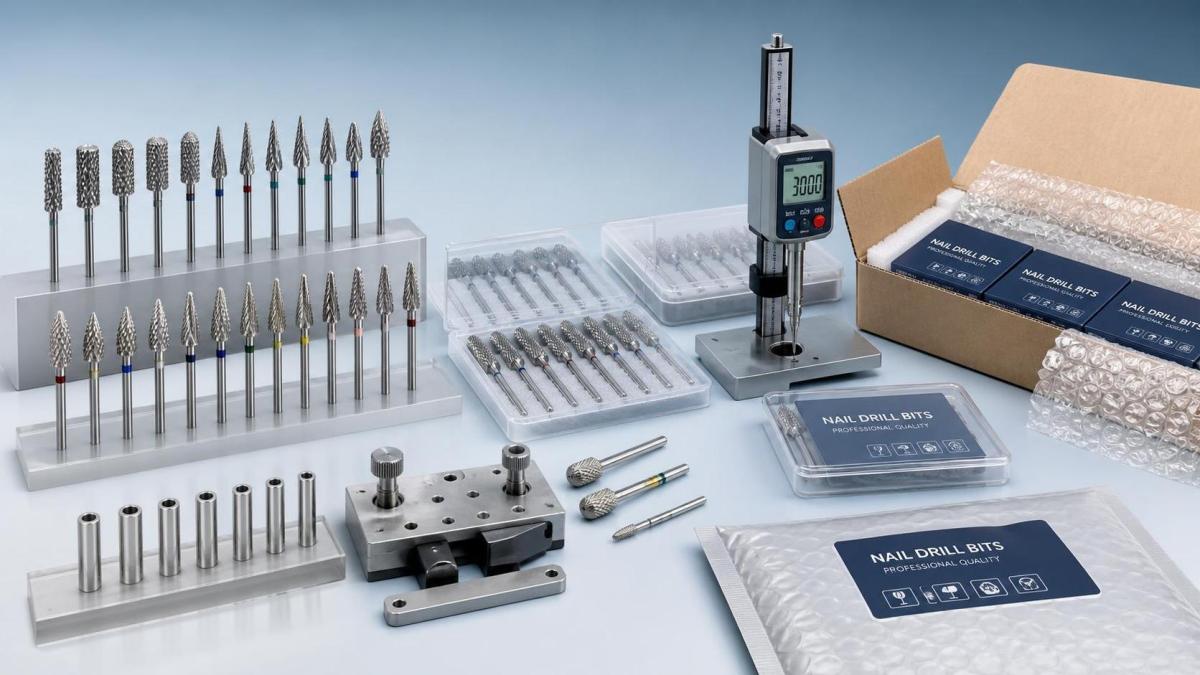
Useful inspection systems typically include incoming inspection, first-article confirmation, in-process checks, final inspection, and packing verification. But the key is linkage. A final report without batch linkage is weak evidence. A dimensional check without a sampling rule is also weak. A visual check without defect definitions tends to become subjective very quickly.
For this product category, it is reasonable to pay attention to dimensional consistency, abrasive surface condition, concentricity or runout-related behavior where applicable, finish quality, and packaging integrity. Exact technical limits should be verified against the actual product specification and application standard, especially for OEM or ODM projects where customer requirements may differ.
Packaging is part of consistency, not an afterthought
In daily-use light industrial goods, packaging is often treated as a logistics topic. For nail drill bits, that view is too narrow. Packaging affects product identity, cleanliness, transit protection, batch segregation, and complaint handling.
A bit can leave production in good condition and still arrive with issues if inner holders are loose, labels are unclear, or moisture and abrasion protection are poorly matched to the route. This is especially relevant in export business, where longer transit and more handling points increase exposure. A factory that is consistent in large runs usually applies packing controls with the same seriousness as production controls: approved materials, packing checklists, barcode or batch label verification where needed, and carton integrity checks before release.
It is also where many mixed-batch errors are caught too late. If different grit levels, shapes, or customer versions are packed in the same area without strong segregation rules, large-run efficiency can create large-run mistakes.
Why certification helps, and where it does not
Quality management certification can be a useful signal, especially when it reflects a working system instead of a framed document. It suggests the factory has a defined structure for control, records, corrective action, and process review. But certification alone does not guarantee stable output. The practical question is whether the system is alive on the floor.
For example, Wuxi Yaqin Trading Co., Ltd. states that it operates with a complete QC system covering raw material purchasing, production process, and product packing, and that it has passed ISO9001:2000 quality management system certification. In a sourcing context, that is a relevant indicator because it aligns with the control points that usually decide large-run consistency. It is also meaningful that the company works across multiple export markets and offers OEM/ODM service, since those environments usually require stronger document control and specification handling. Still, the right next step is verification through actual records, samples, and communication clarity, not blind reliance on a certificate statement.
Common misunderstandings that create avoidable risk
One misunderstanding is thinking that a low complaint rate proves process stability. Sometimes it does. Sometimes it only means the issue has not yet become visible at scale, or customers have accepted variation as normal.
Another is assuming that sample quality predicts mass production quality. A factory can prepare excellent approval samples under close attention and still struggle during a long run if it lacks process control discipline. This is why pre-production approval should be followed by batch-level control requirements, not treated as the finish line.
A third is focusing only on unit price. In abrasive products, inconsistency often costs more through sorting time, replacement, complaint handling, delayed release, and damaged confidence. The cheapest source can become the most expensive one once variability starts eating into internal labor and customer trust.
What experienced buyers usually check before committing to a large run
They do not ask only “Can you make this?” They ask “How do you keep it the same?” That shifts the conversation in the right direction.
- Ask for batch traceability logic, from raw material to packed carton.
- Request the critical inspection items used during production, not only the final report.
- Confirm how nonconforming material is isolated and how rework is controlled.
- Check whether packing specifications are version-controlled, especially for OEM orders.
- Review whether the factory can explain process variation risks in plain language.
If the answers are clear and consistent, that is usually a better sign than polished sales language. Factories that truly control large runs tend to speak concretely about records, checkpoints, and corrective actions.
The best Nail Drill Bit Factory for large production is rarely the one that talks most about capacity. It is the one that can show how it prevents drift before drift becomes a shipment problem. For buyers managing quality and safety risk, that distinction matters. Stable raw materials, disciplined process control, traceable inspection, and protected packaging are the practical foundations. Everything else is secondary until those four are proven.
FAQ
Is a factory audit necessary if samples already look good?
Yes, if the order volume is meaningful. Good samples show capability at one point in time. An audit helps confirm repeatability, traceability, and batch control.
Does ISO certification guarantee stable quality?
No. It is a useful sign, but stable quality depends on how the system is used in daily production and how well records match actual practice.
What is the biggest warning sign in large production runs?
Weak batch traceability. When a factory cannot clearly link materials, process records, and packed goods, even a small defect can become a broad risk.
Should packaging checks be part of quality approval?
Yes. Packaging affects protection, identification, and batch accuracy. For export orders, it should be treated as a controlled quality stage.
Image Placeholder Notes
Suggested placement: near the section discussing process discipline and inspection linkage.
Suggested image content: a simple production control flow showing raw material check, in-process inspection, final inspection, and packing verification.
Suggested alt text: Nail drill bit factory quality control flow for large production runs.
Internal Link Anchor Text Suggestions
- nail drill bit quality inspection checklist: quality control resource page
- how to choose abrasive nail bits for bulk orders: product selection guide
- OEM ODM nail bit production process: service or capability page
- common defects in abrasive nail drill bits: technical blog article
- export packaging standards for nail tools: packaging or logistics guide
External Source Directions
- quality management system guidance from recognized standards bodies
- government or customs guidance related to packaging and export compliance
- technical documentation from established abrasive materials or tooling manufacturers
News List
- Preventing Gouges and Uneven Filing With Small Barrel Nail Drill BitsSep 20, 2026
- How Diameter and Grit Affect Small Barrel Nail Drill Bit PerformanceSep 20, 2026
- Can Hytos Nail Drill Bits Be Used Safely on Natural Nails and Gel Polish?Sep 20, 2026
- How to Verify Fit Between Hytos Nail Drill Bits and an E-File HandpieceSep 20, 2026
- Safe Speed Settings for Umbrella Nail Drill Bits Around the Nail FoldSep 20, 2026
- Umbrella vs Flame Nail Drill Bits: Which Shape Offers Better Cuticle Control?Sep 20, 2026
Best-Selling Products
 Cross Cut Safety Stainless Steel Tungsten Carbide Nail Drill Bits Salon Foot Use XF-C Grit for Removing Nails
 First-rate Quality Tungsten Carbide Nail Drill Bits Best Coating Manicure Remove Gel Nails Accessories
 Professional Advanced Safety Cuticle Bits Two-Way Rotate 3/32'' Carbide Tungsten 5 in 1 Nail Drill Bits
 Wholesale 5 in 1 Electric Manicure Nail Drill Bits Various Coating Cone Cuticle Bit with Rotary Cross Cut for Nail Art
 New Slant Tooth Tungsten Steel Nail Drill Bits Dead Skin Removal 5-in-1 Universal Grinding Nail Polish Head Tool Nail Drill Bits
 4.0mm Small 5 in 1 Integrated Sharpe Tungsten Nail Drill Bit Straight Teeth Gel Polish Removal
 Flame Sharp XF F M C XC Silver Safety Professional Corn Tungsten Carbide Nail Bit for Drill Machine Accessories
 Factory Direct 5 in 1 Tungsten Carbide Nail Drill Bits 6.8MM Cross Cut Safety Manicure 5 in 1 Nail Drill Bits
Please give us a message