
What to check before sourcing a China electric nail file for resale
What to check before sourcing a China electric nail file for resale
Sometimes the sourcing problem does not show up when you first compare suppliers. It shows up later, when the shipment arrives, the machine handpieces feel inconsistent, the speed control is less stable than expected, or the packaging looks too generic for the market you are trying to enter. If you are preparing to add a China electric nail file to your resale line, this is usually the point where a low unit price stops looking attractive and starts looking expensive.
A common situation is this: you find several factories offering a very similar product, the photos look almost the same, and the specifications on paper are close enough that it becomes hard to judge the real difference. For resale, that uncertainty matters. Returns, complaints, weak repeat orders, and delays in private label rollout often come from things that were never checked before the order was placed. The good news is that most of these risks can be reduced if you review the supplier and product in a more practical way.
When similar listings hide very different products
One reason buyers struggle with this category is that the visible product is only part of the decision. An electric nail file is not just a shell color and a speed number. You are also buying motor consistency, vibration control, bit fit, cable quality, packaging execution, spare-part stability, and the supplier’s ability to keep the same standard over repeated production.
This is where many sourcing decisions go off track. People compare quotes too early. They assume “same appearance” means “same performance,” or they focus on one feature such as RPM while ignoring the parts that affect daily use. For resale, especially if you want fewer after-sales issues, the better question is not “Which supplier is cheapest?” but “Which supplier is easier to trust over time?”
Start with the use case, not the catalog page
Before checking samples, it helps to define where the product will be sold and who will use it. A China electric nail file meant for entry-level retail channels may not need the same positioning as one intended for salon supply distribution or professional beauty wholesalers. If your market expects portable units, quiet operation, and gift-ready packaging, your evaluation should reflect that. If your market is more service-focused, durability and stable batch quality may matter more than visual styling.
This sounds basic, but it changes the whole sourcing conversation. Once the intended market is clear, you can ask better questions:
- Is the product aimed at occasional users or frequent salon use?
- Will you need your own packaging, logo, manual, or accessory configuration?
- Does your channel need consistent restocking rather than one-off promotional buys?
- Are returns likely to come from performance complaints or from packaging and labeling problems?
Without this step, buyers often request samples that look acceptable but do not fit the actual selling environment.
The checkpoints that matter before you place an order
Once you know the intended market, the review becomes much more concrete. Instead of relying on a broad promise of “good quality,” work through the product in layers.
1. Mechanical feel and control stability
For an electric nail file, the first hands-on check should be consistency rather than appearance. During sample review, pay attention to whether the handpiece feels balanced in the hand, whether vibration stays controlled at different speed levels, and whether the speed adjustment responds smoothly instead of jumping abruptly. A unit can look polished in photos and still create a poor user experience if the handpiece heats up too quickly or sounds rough during operation.
If you are comparing multiple samples, test them the same way each time. Short, casual handling is rarely enough. Switch speeds gradually, stop and restart the unit, check connector tightness, and observe whether the machine feels stable after continuous use. Even without formal laboratory testing, a structured comparison often reveals obvious gaps.
2. Compatibility with bits and accessories
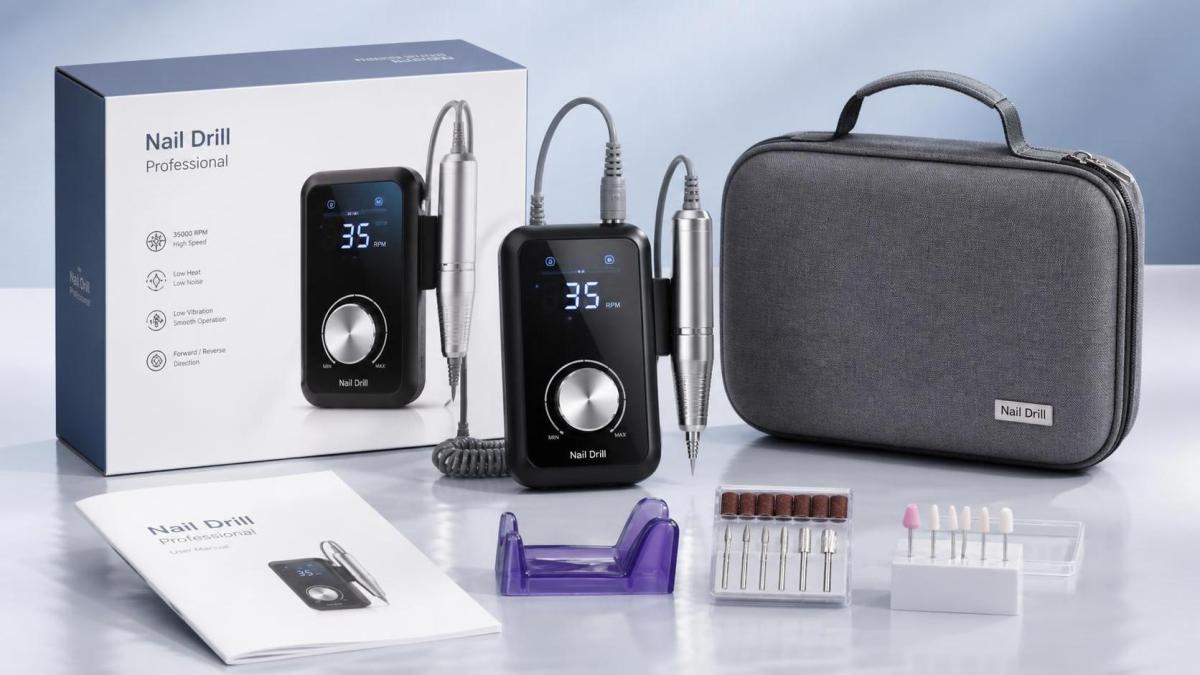
Another issue that gets overlooked is fit consistency. If the collet or chuck does not hold bits securely, the end user may experience wobble, reduced precision, or premature wear. For resale, this can turn into complaints that are hard to solve because the problem appears after opening the product and using it with normal accessories.
Ask the supplier how bit fit is checked during production. If abrasive products or nail bits are part of your broader line, compatibility becomes even more important. The machine should work reliably with standard accessory expectations in your target market, and the supplier should be able to explain how they manage this, not simply say “it is no problem.”
3. Build consistency across batches
A sample can be acceptable and the bulk order can still disappoint if the factory does not control incoming materials and assembly in a disciplined way. This is why quality control should be reviewed as a process, not a slogan. You want to understand how raw materials are checked, how production steps are monitored, and how finished goods are inspected before packing.
Some suppliers can clearly describe their internal workflow: incoming material review, in-process checks, and packing inspection. That kind of detail matters more than a generic statement about “strict QC.” If a supplier already has a complete QC system covering purchasing, production, and packing, that is relevant because resale risk usually comes from inconsistency between the approved sample and shipment quality.
4. OEM and ODM practicality
Private label requests often look simple on paper and become messy in execution. A logo print, a custom color box, an insert card, or a manual in your preferred language all introduce more chances for error. If the supplier offers OEM or ODM support, check how this is actually handled. Do they confirm artwork carefully? Can they review packaging requirements before mass production? Do they understand that retail presentation and transport protection are not the same thing?
This is one area where experience helps. A supplier that regularly handles OEM/ODM work is usually better at spotting packaging conflicts, labeling omissions, or design details that may create delays. That does not eliminate risk, but it makes communication more practical.
Why packaging deserves more attention than many buyers give it
Packaging is often treated as the last step, but for resale it affects more than appearance. It influences customer perception, warehouse handling, online listing presentation, and damage rates during transit. A strong machine packed poorly can still become a return problem.
When reviewing a supplier for a China electric nail file, ask to see the packaging method in addition to the product itself. Check whether the inner support protects the handpiece and main unit from movement, whether accessories are organized clearly, and whether the outer carton appears suitable for export handling. If your channel requires branded presentation, make sure the packaging can support that without reducing practical protection.
Also look at details that are easy to miss during a fast review: print clarity, label position, language layout, barcode area, instruction placement, and accessory count control. Small mistakes here can delay customs clearance, disrupt shelf presentation, or create confusion for the final buyer.
Certifications and documentation: useful, but only if they match the product you will actually receive
Documents matter, but they should be checked with the same care as the sample. A common mistake is accepting certificates or management claims without confirming whether they relate to the actual factory operation and product line involved in your order.
If a supplier says their management system is certified, treat that as one positive signal, not the whole answer. It suggests a certain level of process discipline, but it does not replace product review, packing checks, and communication testing. The more useful approach is to ask how their documented processes connect to your order: approval flow, inspection points, packaging confirmation, and shipment release.
In other words, documents help when they support visible working habits. They do not help much when they are used to avoid practical questions.
Delivery reliability is not just about lead time promises
Many buying problems begin with a lead time that looked fine during quotation but became unreliable once artwork revisions, accessory confirmation, or packing details were introduced. This is especially common when the supplier can produce the product but is less prepared to manage coordination from production to delivery.
Before ordering, ask how they handle the full sequence: sample approval, packaging confirmation, production scheduling, inspection, and shipment arrangement. A supplier that can provide one-stop coordination from production to delivery may reduce handoff errors, especially when your order includes customized packaging or mixed accessories.
Reliable delivery is not only “Can they ship fast?” It is also “Can they keep the order accurate while moving it forward?” For resale, accuracy and timing usually matter together.
How to compare suppliers when every quote looks reasonable
If you are stuck between several options, it helps to stop comparing by price alone and instead score the suppliers by decision friction. Which one answers clearly? Which one understands the target market without being pushed repeatedly? Which one can explain QC in operational terms? Which one handles sample adjustments without confusion?
In practice, a workable comparison often comes down to five areas:
- Sample consistency and operating feel
- Clarity of QC process during production and packing
- Ability to handle OEM/ODM details accurately
- Packaging suitability for your channel
- Communication discipline before the order is placed
This method is useful because pre-order communication usually predicts post-order communication. If basic details are hard to confirm early, they rarely become easier once production starts.
Where an experienced trading factory can fit into the decision
For some buyers, especially those managing broader nail or abrasive product lines, it can be helpful to work with a supplier that already understands export process control and product coordination across categories. A trading factory focused on abrasive products and related export work may be better positioned to discuss accessory fit, packing control, and OEM/ODM execution in a realistic way, provided those capabilities can be verified through samples and communication.
For example, if a supplier can show that their quality control covers raw material purchasing, production steps, and product packing, that gives you a clearer base for evaluation. If they also have experience supporting OEM/ODM projects and coordinating production-to-delivery service, that may reduce operational friction for resale programs. The key is not to assume these strengths; it is to confirm them through the way your inquiry is handled.
Signs that you should slow down before confirming the order
There are a few warning signs that deserve attention even when the quote is attractive. One is vague answers to simple technical questions. Another is reluctance to discuss packaging details before deposit. A third is overconfidence without supporting process explanation. If you ask how consistency is controlled and the reply stays at the level of “our quality is very good,” you still do not have the information you need.
You should also pause if the sample and the quotation seem disconnected. If the sample quality is acceptable but the final order specification is not written clearly, that gap can become a problem later. In this category, small ambiguities around accessories, plug types, manuals, labeling, or color box details can cause real commercial issues.
A more grounded way to make the final choice
Choosing a China electric nail file for resale is rarely about finding the perfect factory. It is about finding a supplier that can be checked properly, communicates clearly, and maintains enough process control to support repeat business. A lower quote may still be the right choice if the basics are solid. A higher quote may be worth it if it prevents avoidable returns, relabeling work, or packaging failures.
When in doubt, come back to the resale reality: can this supplier help you ship a product that looks right, works consistently, matches the approved sample, and arrives in packaging that supports your market? If the answer is yes because you have verified the details, not because you were reassured by broad claims, then the sourcing decision is on firmer ground.
That is usually the difference between a trial order that creates extra work and a product line that is easier to build on. In this category, the most useful checks are often the least flashy ones: fit, consistency, packaging discipline, and communication before money changes hands.
News List
- Preventing Gouges and Uneven Filing With Small Barrel Nail Drill BitsSep 20, 2026
- How Diameter and Grit Affect Small Barrel Nail Drill Bit PerformanceSep 20, 2026
- Can Hytos Nail Drill Bits Be Used Safely on Natural Nails and Gel Polish?Sep 20, 2026
- How to Verify Fit Between Hytos Nail Drill Bits and an E-File HandpieceSep 20, 2026
- Safe Speed Settings for Umbrella Nail Drill Bits Around the Nail FoldSep 20, 2026
- Umbrella vs Flame Nail Drill Bits: Which Shape Offers Better Cuticle Control?Sep 20, 2026
Best-Selling Products
 Cross Cut Safety Stainless Steel Tungsten Carbide Nail Drill Bits Salon Foot Use XF-C Grit for Removing Nails
 First-rate Quality Tungsten Carbide Nail Drill Bits Best Coating Manicure Remove Gel Nails Accessories
 Professional Advanced Safety Cuticle Bits Two-Way Rotate 3/32'' Carbide Tungsten 5 in 1 Nail Drill Bits
 Wholesale 5 in 1 Electric Manicure Nail Drill Bits Various Coating Cone Cuticle Bit with Rotary Cross Cut for Nail Art
 New Slant Tooth Tungsten Steel Nail Drill Bits Dead Skin Removal 5-in-1 Universal Grinding Nail Polish Head Tool Nail Drill Bits
 4.0mm Small 5 in 1 Integrated Sharpe Tungsten Nail Drill Bit Straight Teeth Gel Polish Removal
 Flame Sharp XF F M C XC Silver Safety Professional Corn Tungsten Carbide Nail Bit for Drill Machine Accessories
 Factory Direct 5 in 1 Tungsten Carbide Nail Drill Bits 6.8MM Cross Cut Safety Manicure 5 in 1 Nail Drill Bits
Please give us a message