
How to compare minimum order terms from nail drill bit suppliers in Poland
How to compare minimum order terms from nail drill bit suppliers in Poland
When evaluating a nail drill bit supplier Poland distributors can work with, minimum order terms often shape much more than the unit price. They affect how quickly you can test new SKUs, how much capital is tied up in stock, whether private label plans are realistic, and how much pressure sits on your warehouse when demand shifts. In the Polish nail products market—where professional salons, independent technicians, and e-commerce resellers often buy in different patterns—MOQ discussions should be treated as a commercial risk assessment, not a routine quotation detail.
For dealers, agents, and wholesalers, comparing MOQ, OEM/ODM support, quality control, and delivery reliability is essential before placing bulk orders. A supplier offering a low opening MOQ may still become expensive if packaging options are rigid, mixed-model orders are limited, or replenishment cycles are unstable. On the other hand, a supplier with a higher minimum may be commercially stronger if it supports assortment flexibility, consistent finishing quality, and repeatable lead times.
The practical question is not “Which supplier has the lowest MOQ?” but “Which minimum order structure best fits my channel, stock model, and margin target?”
MOQ is rarely one number
Many buyers new to sourcing compare MOQ as if it were a single line in a spreadsheet. In reality, nail drill bit suppliers often apply minimums across several layers:
- MOQ per item
- MOQ per size or grit variation
- MOQ per packaging format
- MOQ per private label design
- MOQ per total order value
- MOQ for custom accessories, barcode labels, or inserts
This matters especially in nail drill bits because the product line is naturally fragmented. A distributor may need flame bits, cone bits, safety bits, barrel shapes, and multiple diameters to serve salons and training schools. If one Polish-facing supplier quotes a low MOQ on a single SKU but forces full-carton ordering by size, the practical order threshold may be far higher than it first appears.
A better comparison method is to ask every supplier the same five questions:
- What is the minimum per SKU?
- Can sizes and shapes be mixed within one order?
- Is there a minimum by color ring, grit, or finish type?
- What is the MOQ for neutral packaging versus OEM packaging?
- What order value is required to keep the quoted price valid?
Without these details, MOQ comparisons are often misleading.
For distributors, the real cost of MOQ is inventory exposure
In Poland, nail supply distribution is not only about moving volume to large salon chains. A significant share of demand may come from smaller professional studios, beauty schools, mobile technicians, and online retail buyers who order in uneven rhythms. That makes inventory depth more sensitive than in a standardized industrial category.
If a supplier requires 3,000 pieces per shape and your market only turns 300 pieces per month in that design, you are not buying product—you are buying six to ten months of inventory risk. That risk shows up in several ways:
- cash tied up in slow-moving stock;
- higher storage and internal handling costs;
- greater discounting pressure if demand shifts;
- less budget left for new launches;
- difficulty refreshing packaging or branding later.
This is why seasoned importers often accept a slightly higher unit price in exchange for a lower and more flexible MOQ. In practical terms, a 5% to 8% higher purchase cost may be cheaper than carrying excess stock for two quarters.
Low MOQ does not automatically mean low-risk sourcing
There is a common assumption that the lower the MOQ, the better the supplier. That is not always true.
Some low-MOQ suppliers make small opening orders attractive but recover margin elsewhere: weaker finish consistency, limited QA filtering, slow replenishment, or expensive freight inefficiency because order sizes remain too small to optimize shipment planning. For nail drill bits, where end users are sensitive to concentricity, abrasive adhesion, corrosion resistance, and shape precision, poor consistency can damage distributor reputation quickly.
A flame bit that looks acceptable in sample photos but performs inconsistently across a batch may create customer complaints about vibration, rough finishing, or premature wear. In the salon market, those issues spread fast through technician communities.
That is why MOQ should be evaluated together with process stability. For example, if a supplier can explain its raw material controls, abrasive application method, batch inspection, and packing checks, its higher minimum may be easier to justify than a low-MOQ offer with vague production answers.
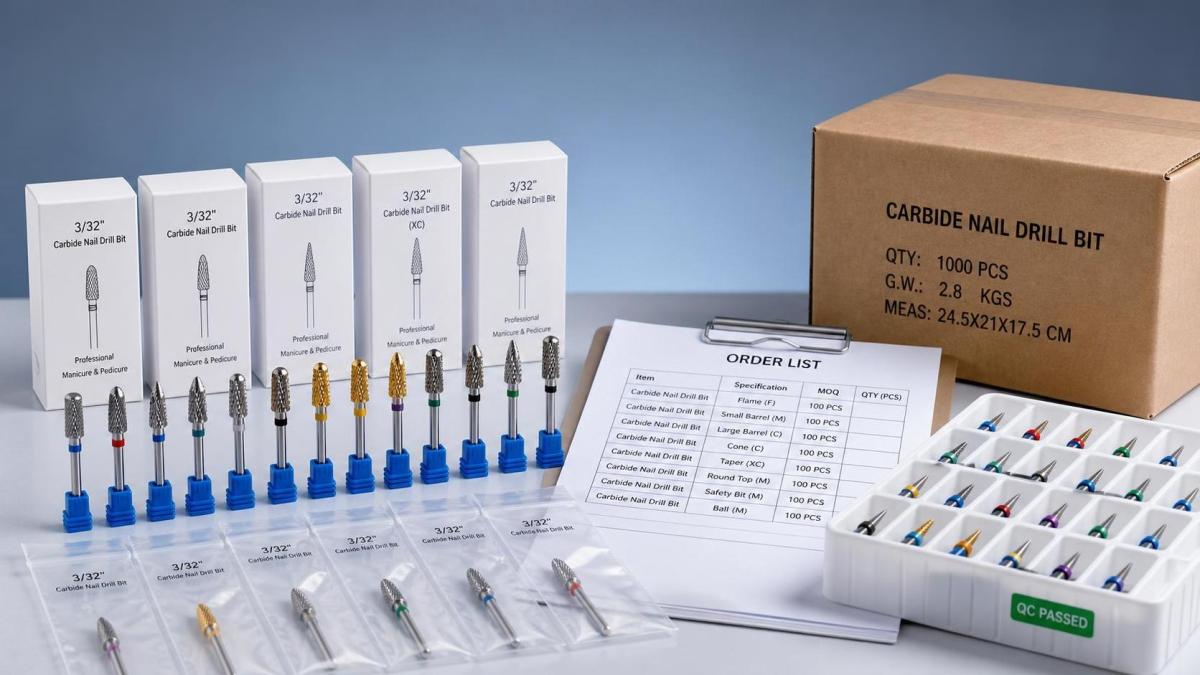
What to compare beyond MOQ when reviewing suppliers
MOQ only becomes meaningful when tied to the rest of the trading terms. For distributors and agents, four areas deserve close attention.
1. Assortment flexibility
The nail bit category sells as a system, not as isolated items. If a supplier only allows bulk purchase of high-volume standard shapes, it may not support your need to build a balanced catalog. Ask whether you can combine multiple profiles and dimensions in one order.
Take a detail-level example: a supplier may offer a precision cuticle line such as 2*8mm Flame Bit Diamond Nail Drill Bits Stainless Steel Cuticle Remover Burr in several related dimensions, including 1.8mm/9mm, 2.2mm/8.5mm, 2.45mm/7.5mm, and 2.7mm/8mm. For a distributor, the issue is not whether one size is available, but whether these variants can be mixed in manageable quantities to match professional demand for Russian manicure, Japanese manicure, and pedicure applications. If each size requires a separate minimum, the assortment may become commercially heavy even when the headline MOQ seems low.
2. Private label threshold
Many suppliers accept low MOQ for neutral stock but set much higher minimums for custom printing, blister cards, pouches, labels, or outer cartons. If your route to market depends on building your own brand, compare:
- MOQ for logo printing;
- MOQ for custom packaging artwork;
- design/setup charges;
- barcode and language labeling support;
- ability to combine SKUs under one brand order.
In distribution, this is often where the real commercial threshold appears. A factory-friendly MOQ may not translate into a brand-friendly MOQ.
3. Reorder reliability
Opening orders are less important than repeat orders. If a supplier offers flexible trial quantities but lead times stretch unpredictably during peak seasons, you may still face stockouts. Ask for typical production lead times and whether repeat orders can be prioritized when the same specifications are used again.
For practical comparison, it helps to separate:
- sample lead time;
- first bulk order lead time;
- repeat order lead time;
- lead time for OEM packaging;
- lead time during pre-holiday or peak export periods.
4. Quality control transparency
In abrasive products, visible appearance is only part of quality. Buyers should ask how the supplier controls base material quality, abrasive coating consistency, dimensional accuracy, and packing integrity. A supplier with a complete QC system covering raw material purchasing, production, and final packing is generally easier to evaluate than one that only provides a basic product sheet.
If the supplier mentions management certifications such as ISO9001:2000, treat that as one signal rather than a complete guarantee. The useful follow-up is operational: what defect criteria are checked, how are non-conforming batches handled, and what complaint process exists after delivery?
How to translate MOQ into a workable cost model
Distributors should stop looking at MOQ in isolation and start converting it into a landed inventory model. A simple calculation framework can make supplier comparison much clearer:
- purchase cost per MOQ batch;
- estimated freight cost per unit at that batch size;
- import-related charges and domestic handling;
- average storage duration before sell-through;
- expected defect/replacement rate;
- markdown risk for slower SKUs.
Two offers can look similar on paper and behave very differently in cash flow. For example:
- Supplier A: lower unit price, higher MOQ, slower turnover
- Supplier B: higher unit price, mixed-SKU flexibility, lower stock pressure
For an importer serving fragmented demand, Supplier B may produce better annual margin because inventory turns faster and obsolete stock falls. This is particularly relevant when building a professional bit assortment across multiple shapes and treatment uses.
Questions Polish distributors should ask about market fit
Not every supplier structure suits the Polish market equally well. Before comparing MOQ terms, clarify your own channel profile.
If your business mainly supplies professional salons, consistency and replenishment speed usually matter more than the absolute lowest first-order cost. Technicians reorder proven shapes repeatedly and are sensitive to handling precision.
If your business leans toward retail and e-commerce, packaging flexibility, barcode readiness, and broad assortment may be more important. In that case, a supplier that supports mixed orders and smaller branded runs may outperform a pure bulk producer.
If you serve training academies or beauty schools, durability and standardization across student kits become important. MOQ should be evaluated against repeatability of the same bit geometry and finish from batch to batch.
These channel differences explain why there is no universally “best” MOQ. There is only a best MOQ structure for your sell-through model.
Watch for hidden restrictions in “negotiable MOQ” offers
Suppliers often say MOQ is negotiable. Sometimes that is true. Sometimes it only means they can reduce the initial quantity while adjusting terms elsewhere.
Check whether “negotiable” means:
- a higher price tier;
- neutral packaging only;
- limited shape or size options;
- no exclusivity discussion;
- longer lead times;
- acceptance of stock leftovers from previous production runs.
None of these are automatically unacceptable. They just need to be visible in the comparison. A negotiable MOQ that removes custom packaging, for instance, may still work for a market test. But it is not the same commercial proposition as a low MOQ with full branding support.
Why OEM/ODM capability matters even when you start with standard goods
Many distributors begin with standard catalog bits, then move into differentiation later. A supplier’s OEM/ODM capability therefore matters before you need it. If the partner can support packaging adaptation, custom assortments, and product presentation upgrades as your sales grow, switching costs later stay lower.
In nail drill bits, differentiation often comes less from inventing a new bit shape and more from how the line is configured, labeled, packaged, and positioned for end users. A supplier that already has experience serving export markets and handling one-stop production-to-delivery coordination may be better equipped to scale with your brand.
That does not mean every distributor should jump into ODM immediately. It means MOQ discussions should include a forward-looking question: if this range sells well in Poland, what will the second-stage cooperation look like?
Common buying mistakes when comparing nail drill bit suppliers
The most frequent mistakes are surprisingly consistent across importers:
- choosing on unit price without calculating inventory carrying cost;
- comparing MOQ headlines without checking mixed-SKU rules;
- treating sample quality as proof of batch consistency;
- ignoring packaging minimums until late-stage negotiation;
- failing to test reorder responsiveness before scaling;
- underestimating the importance of finish stability in professional-use bits.
A more subtle mistake is overbuying niche sizes too early. Some precision profiles and dimensions are valuable for advanced technicians, but demand concentration is usually narrower. Products built for delicate skin work, cuticle pre-lifting, side lines, or adherence removal can be commercially attractive, yet they should be introduced in line with channel maturity, not just supplier enthusiasm.
A more useful way to choose a supplier
If you are comparing suppliers for the Polish market, the strongest choice is usually not the one with the lowest entry barrier. It is the one whose minimum order terms align with your turnover speed, assortment strategy, and brand plans while still giving you confidence in quality and delivery repeatability.
In practical sourcing terms, that means shortlisting suppliers that can answer clearly on MOQ structure, mixed-order flexibility, OEM thresholds, quality control, and repeat-order lead times. Once those factors are visible, pricing becomes easier to interpret—and much less likely to surprise you later.
For distributors, agents, and wholesalers, minimum order terms are not a purchasing footnote. They are an early indicator of whether a supplier relationship will stay manageable as the business grows.
News List
- Are China nail drill bit suppliers a good fit for private label linesAug 26, 2026
- What certifications matter when reviewing a nail drill bit supplier in the UKAug 25, 2026
- How shipping costs affect bulk orders from a nail drill bit supplier in CanadaAug 25, 2026
- What materials are most common from a nail drill bit supplier in ItalyAug 25, 2026
- How to compare minimum order terms from nail drill bit suppliers in PolandAug 25, 2026
- When does an Australia nail drill bit supplier make sense for local salonsAug 25, 2026
Best-Selling Products
 Cross Cut Safety Stainless Steel Tungsten Carbide Nail Drill Bits Salon Foot Use XF-C Grit for Removing Nails
 First-rate Quality Tungsten Carbide Nail Drill Bits Best Coating Manicure Remove Gel Nails Accessories
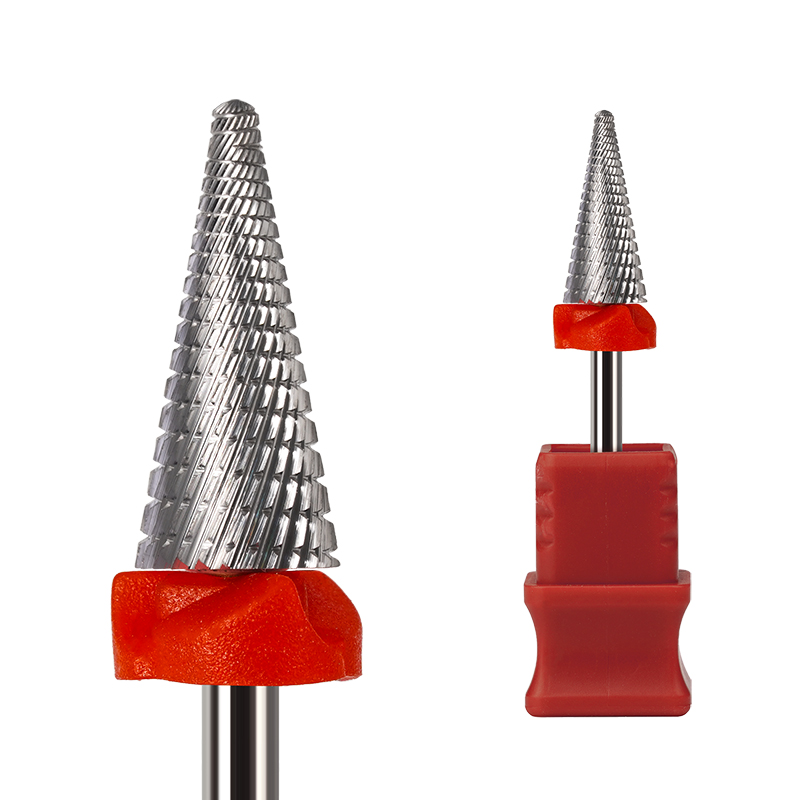
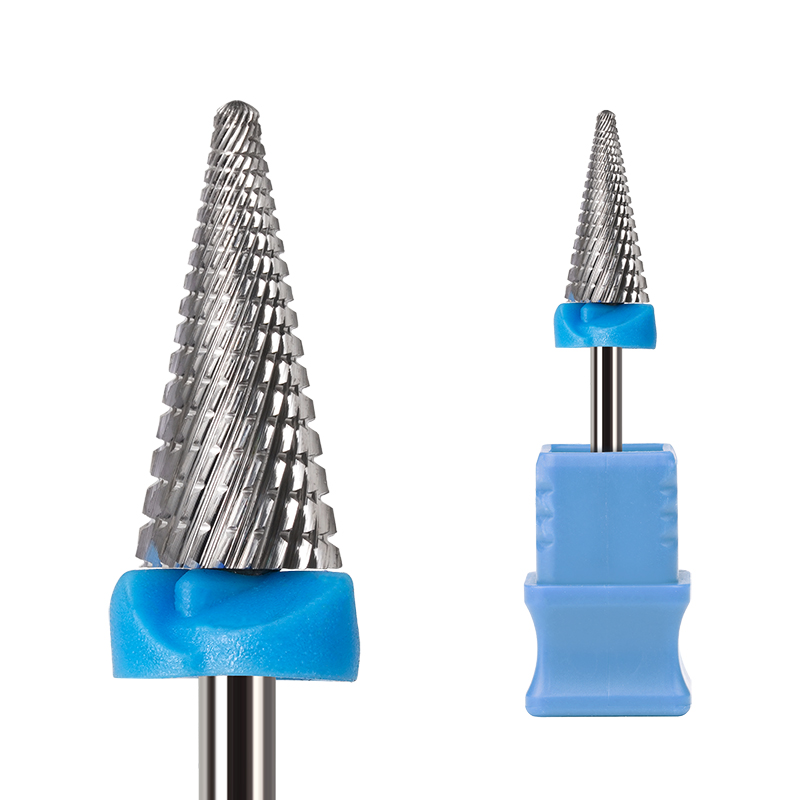
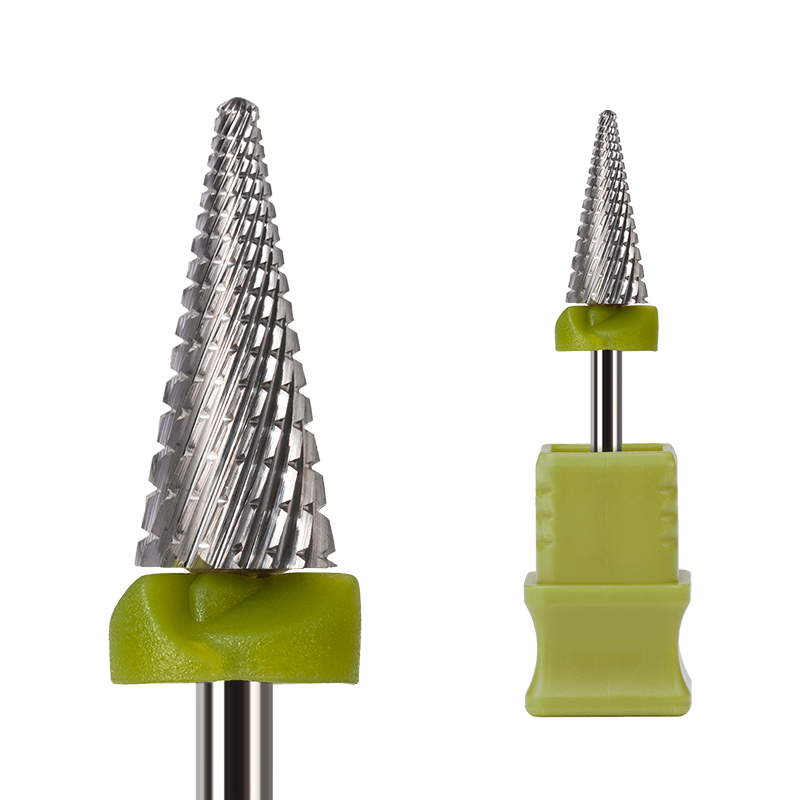
 Professional Advanced Safety Cuticle Bits Two-Way Rotate 3/32'' Carbide Tungsten 5 in 1 Nail Drill Bits
 Wholesale 5 in 1 Electric Manicure Nail Drill Bits Various Coating Cone Cuticle Bit with Rotary Cross Cut for Nail Art
 New Slant Tooth Tungsten Steel Nail Drill Bits Dead Skin Removal 5-in-1 Universal Grinding Nail Polish Head Tool Nail Drill Bits
 4.0mm Small 5 in 1 Integrated Sharpe Tungsten Nail Drill Bit Straight Teeth Gel Polish Removal
 Flame Sharp XF F M C XC Silver Safety Professional Corn Tungsten Carbide Nail Bit for Drill Machine Accessories
 Factory Direct 5 in 1 Tungsten Carbide Nail Drill Bits 6.8MM Cross Cut Safety Manicure 5 in 1 Nail Drill Bits
Please give us a message