
How does grit affect the right Nail Drill Bit for each salon service?
How does grit affect the right Nail Drill Bit for each salon service?
The right Nail Drill Bit is not simply the sharpest or fastest one available. Its grit must match the material being worked on, the area of the nail, and the level of control the service requires. A grit that removes product efficiently on an acrylic enhancement can be too aggressive for natural nail preparation. A fine bit that gives a polished finish may be too slow for bulk removal.
For salon work, grit affects four practical outcomes: removal speed, surface control, friction and heat, and the finish left behind. Selecting by grit first, then confirming the bit shape and material, helps create a more consistent service while reducing unnecessary stress on the natural nail.
What grit changes during a salon service
Grit refers to the coarseness of the cutting or abrasive surface. In simple terms, a coarser grit has larger, more pronounced cutting edges and removes material more quickly. A finer grit has smaller cutting edges and removes material more gradually, leaving a smoother surface.
That difference matters because salon services involve very different materials. Builder gel, hard gel, acrylic, dip powder, gel polish, and natural keratin do not respond in the same way. The operator also changes the result through hand pressure, drill speed, contact angle, and how long the bit stays in one area. Grit is therefore not an isolated choice; it determines how forgiving the bit will be when these operating conditions vary.
A coarse bit can shorten removal time on thick enhancement product, but it has a narrower margin for error around the sidewalls, stress area, and natural nail. A fine bit gives more control near delicate areas, but prolonged use with excessive pressure can still generate friction. The aim is not to use the finest grit for every service. It is to use the least aggressive grit that can complete the task cleanly and efficiently.
Match the grit to the work, not the whole appointment
A single appointment may require more than one bit. Trying to complete every stage with one medium or coarse bit usually leads to avoidable compromises: slow removal in one stage, then overly aggressive work in another. It is more practical to think in terms of the exact task in front of the operator.
The practical sequence is often more important than the initial choice. During a removal service, use a medium or appropriately coarse Nail Drill Bit to reduce bulk while leaving a controlled layer of product above the natural nail. Then change to a fine bit, hand file, or buffer for the remaining work. This transition lowers the chance of suddenly reaching the natural nail with an aggressive cutting surface.
Fine grit is for control, not just for beginners
Fine-grit bits are frequently associated with gentle work, but their value extends beyond basic services. They are useful whenever the operator needs to see and feel small changes in the surface rather than remove large amounts of product. This includes smoothing a gel overlay, blending a product transition near the cuticle, refining a repaired corner, and preparing a natural nail before product application.
For natural nails, fine grit is usually the safer direction because the goal is limited: remove shine or lightly even the surface, not reduce nail thickness. A natural nail can become weak when it is repeatedly over-filed, even if the bit itself is labeled as suitable for manicure work. The warning sign is not only visible grooves. A client may report heat, sensitivity, or a flexible, weakened nail after the service.
Fine grit also gives a better finish before color application. A rough surface created by a more aggressive bit may need additional refining, which can erase any time saved during the earlier stage. When the service calls for a smooth overlay or a clean polish result, the finishing step should use a grit that is capable of leaving a controlled surface.
When medium grit is the more useful salon standard
Medium grit is often the most versatile option for enhancement services because it can remove gel product, refine acrylic structure, reduce thickness, and reshape extensions without being as forceful as a coarse cutter. It works particularly well when the product layer is substantial but the operator still needs to maintain visibility and control.
Its limitation is that “medium” does not automatically make a bit safe for every zone. Bit shape still affects the contact area. A flat-head cylinder presents a broad working surface and is useful for leveling larger enhancement areas, while a tapered or rounded form can offer more control around curves and product transitions. A medium-grit cylinder used flat against the nail can remove material quickly; the same bit used with excessive pressure around a sidewall can still cause damage.
Choose medium grit when the service involves product correction rather than purely cosmetic finishing: shortening an extension, reducing a bulky apex, rebalancing grown-out enhancement, or removing most of a durable coating before refinement. If the client has thin, peeling, or previously over-filed natural nails, leave more product as a protective layer and move earlier to a fine finishing tool.
Coarse grit has a place, but it should not become the default
Coarse bits are designed for efficient material removal. They can be appropriate for dense acrylic, thick hard gel, or major length reduction, especially when the operator is working primarily on the enhancement rather than the natural nail. In those situations, slow removal with an overly fine bit can encourage extra pressure and prolonged friction, which is not necessarily gentler.
The risk comes from treating coarse grit as a universal time-saving tool. It is poorly suited to cuticle cleanup, direct natural nail preparation, and final smoothing. It also requires disciplined movement. Keep the bit moving, use light pressure, inspect the remaining product layer frequently, and reduce drill speed as the work approaches the natural nail or sensitive side areas.
Heat is often blamed on the bit alone, but it usually reflects an interaction between grit, pressure, speed, bit cleanliness, and dwell time. A coarse bit can create heat when held in place. A clogged bit can drag instead of cut. A fine bit can also heat the surface if it is forced to remove material beyond its intended capacity. Changing grit at the right stage is one of the simplest ways to reduce these problems.
Choose grit together with bit shape and cutting direction
Grit tells you how aggressively a bit works; shape tells you where and how it contacts the surface. Both must support the service.
- Round cylinder and flat-head cylinder bits are practical for broad product surfaces, leveling, and controlled bulk reduction.
- Corn-shaped bits suit general product removal because their profile can follow the nail structure while maintaining a useful working area.
- Round cone bits offer more precision around curves, side areas, and detailed refinement, but they should still be selected in a gentle grit for close work.
- Large round-head bits are intended for controlled work in areas where a sharp edge would be unsuitable; grit and drill technique remain important.
Carbide and tungsten-steel bits are commonly chosen for product removal because their cutting surfaces are durable and efficient on enhancement materials. Direction also matters. A bit’s flute direction should suit the operator’s dominant hand and the drill’s forward or reverse setting. Using the wrong direction can make the bit feel as though it is skipping or pulling rather than cutting smoothly, encouraging the operator to press harder.
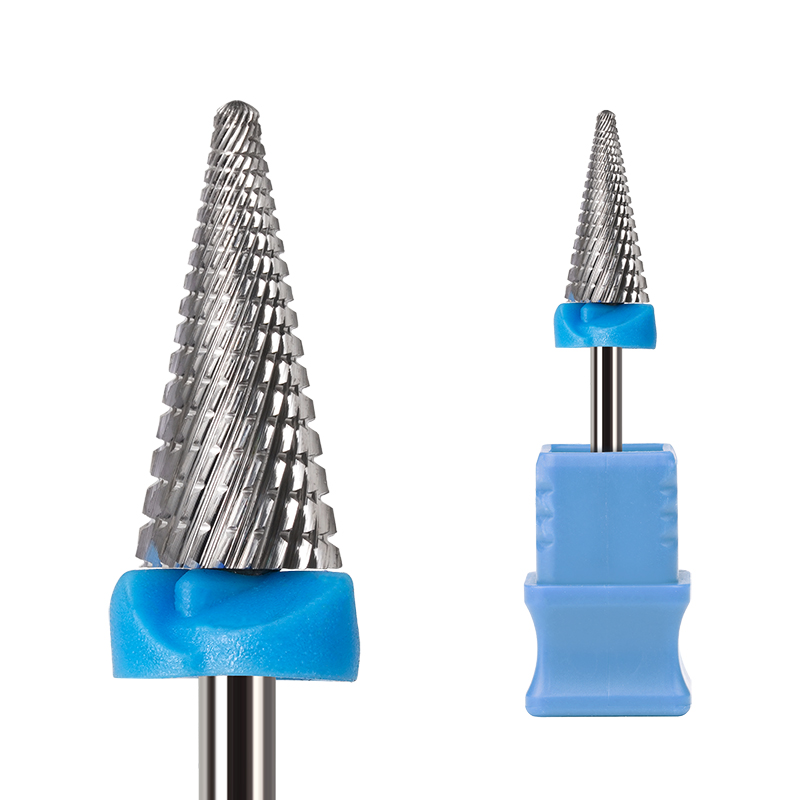
For a practical medium- and fine-grit range, Blue Coated Nail Drill Bits include several shapes, including round cylinder, corn shape, round cone, flat-head cylinder, and large round-head options. Their 2.35 mm shank is a common professional e-file format. The useful selection point is not the blue coating alone, but choosing the shape and grit combination that matches the stage of the service.
A quick decision check before the drill touches the nail
Before selecting a bit, identify the material first. Is the operator removing color, reducing an overlay, rebalancing structured product, or working directly on a natural nail? Next, look at thickness. A thin gel polish layer does not require the same cutting capacity as a thick acrylic extension.
Then decide how close the work will come to the natural nail, cuticle, and sidewalls. The closer the working zone is to delicate tissue or the natural plate, the more a fine grit and a rounded or tapered working profile become useful. Finally, consider the desired endpoint. Bulk removal, structural shaping, and final smoothing are different operations, so they should not automatically use the same bit.
A bit should be replaced or cleaned when its performance changes. A dull or clogged cutting surface can increase drag, create more friction, and make an otherwise suitable grit feel difficult to control. Cleaning and disinfection should follow the bit material and the salon’s established hygiene process; residue left in the flutes reduces cutting efficiency and makes accurate grit selection less meaningful.
Common grit mistakes that affect the finished result
The most common mistake is choosing grit only by speed. Fast removal is useful only while the bit is working on material that can safely be removed at that rate. Another frequent error is using a coarse bit until the product is completely gone. Leaving a thin protective layer and refining it with a finer tool is generally more controlled than trying to expose the bare natural nail with a bulk-removal bit.
Operators also sometimes compensate for a dull bit by increasing pressure. This reduces control and can create heat. Replace the bit or clean the cutting surface instead. Pressure should guide the tool lightly across the surface, not force the bit to cut.
The most reliable salon setup is usually a small, purposeful grit range: fine for preparation and finishing, medium for routine gel and enhancement correction, and coarse only for thick-product removal where the operator can maintain clear control. This approach keeps the service efficient without treating every nail, product system, or treatment stage as the same job.
News List
- Preventing Gouges and Uneven Filing With Small Barrel Nail Drill BitsSep 20, 2026
- How Diameter and Grit Affect Small Barrel Nail Drill Bit PerformanceSep 20, 2026
- Can Hytos Nail Drill Bits Be Used Safely on Natural Nails and Gel Polish?Sep 20, 2026
- How to Verify Fit Between Hytos Nail Drill Bits and an E-File HandpieceSep 20, 2026
- Safe Speed Settings for Umbrella Nail Drill Bits Around the Nail FoldSep 20, 2026
- Umbrella vs Flame Nail Drill Bits: Which Shape Offers Better Cuticle Control?Sep 20, 2026
Best-Selling Products
 Cross Cut Safety Stainless Steel Tungsten Carbide Nail Drill Bits Salon Foot Use XF-C Grit for Removing Nails
 First-rate Quality Tungsten Carbide Nail Drill Bits Best Coating Manicure Remove Gel Nails Accessories
 Professional Advanced Safety Cuticle Bits Two-Way Rotate 3/32'' Carbide Tungsten 5 in 1 Nail Drill Bits
 Wholesale 5 in 1 Electric Manicure Nail Drill Bits Various Coating Cone Cuticle Bit with Rotary Cross Cut for Nail Art
 New Slant Tooth Tungsten Steel Nail Drill Bits Dead Skin Removal 5-in-1 Universal Grinding Nail Polish Head Tool Nail Drill Bits
 4.0mm Small 5 in 1 Integrated Sharpe Tungsten Nail Drill Bit Straight Teeth Gel Polish Removal
 Flame Sharp XF F M C XC Silver Safety Professional Corn Tungsten Carbide Nail Bit for Drill Machine Accessories
 Factory Direct 5 in 1 Tungsten Carbide Nail Drill Bits 6.8MM Cross Cut Safety Manicure 5 in 1 Nail Drill Bits
Please give us a message