
How does a carbide nail drill bit shape affect filing control?
How does a carbide nail drill bit shape affect filing control?
Shape is the primary mechanical control variable
A carbide nail drill bit does not remove material simply because it is sharp. Its shape determines where the cutting edges meet the nail surface, how stable that contact remains during movement, how much of the bit is exposed near sensitive tissue, and how easily the operator can regulate pressure. Two bits made from similar tungsten carbide and cut to the same nominal grit can produce very different filing behavior if one is a wide barrel and the other is a narrow taper.
For filing control, the most important distinction is between contact area and contact precision. A broad profile distributes force across a larger area and is efficient on flat or convex enhancement surfaces. A narrow or tapered profile concentrates action in a smaller zone, improving access and directional control but increasing the consequence of small hand movements. Shape therefore has to be evaluated as part of the working system: bit geometry, flute pattern, rotational speed, handpiece stability, material being removed, and the intended stage of service all interact.
A common evaluation error is to treat a carbide nail drill bit shape as an aesthetic specification. In practice, it is a functional specification. The profile determines whether a bit is suitable for bulk product debulking, controlled apex reduction, sidewall refinement, under-nail cleaning, cuticle-area detailing, or local correction. A bit that is highly effective in one of these tasks can be difficult to control in another.
Why the contact patch changes the filing result
When a rotating carbide bit touches gel, acrylic, poly gel, or another nail enhancement, the actual cutting action occurs along a limited contact patch rather than over the entire bit surface. Shape controls the size and location of that patch.
A large-diameter barrel typically develops a wider, more stable contact area when used parallel to a relatively flat enhancement surface. This can make bulk removal predictable because small changes in angle do not immediately shift the cutting zone to a sharp point or edge. The trade-off is reduced access in narrow spaces. A barrel used carelessly near the proximal nail fold or lateral sidewalls can bring too much active surface into contact at once.
A tapered bit behaves differently. Its working diameter changes along its length, allowing the operator to select a larger or smaller contact zone by changing position. This is useful where the enhancement narrows toward the cuticle or sidewall. However, that flexibility also makes angle control more important. Moving a taper a few millimeters can change both the effective diameter and the local cutting force.
Contact pressure should not be considered independently from shape. The same applied hand force becomes more concentrated when delivered through a small conical or flame-shaped working zone. That can improve localized removal, but it can also increase heat generation and create grooves if the bit is held in one place. A broad bit may feel less aggressive under the same nominal cut because it spreads the load; that does not mean it is inherently safer in every location.
Barrel profiles: stable planes, limited access
Barrel-shaped carbide bits are widely used for reducing the bulk of hard gel, acrylic, and similar enhancement materials. Their geometry supports controlled passes across the central nail plate area, particularly when the goal is to lower thickness while preserving a reasonably even surface.
A standard barrel has relatively parallel sides, so its effective contact width remains consistent over much of the working length. This consistency is valuable during debulking: it helps maintain a uniform removal pattern and reduces the tendency to dig a narrow trench into the product. For technicians working across multiple nail lengths and curvatures, the barrel also provides a recognizable reference surface for keeping the bit aligned with the enhancement rather than pointed down toward the natural nail.
The tip configuration changes the risk profile substantially. A flat-top barrel can reach closer to defined edges and can remove product efficiently from broad surfaces, but the distal edge demands deliberate control. A rounded-top or safety-top barrel reduces the sharp corner presented to skin and adjacent folds. It does not eliminate the need for correct angle, speed, and pressure; it simply lowers the likelihood that a direct edge contact becomes a cutting event.
Barrels are not automatically the best choice for every removal job. On strongly curved nails, a large barrel may contact at its edges rather than along its intended working face. This can make the tool feel unstable and can lead to uneven removal. Diameter must therefore be assessed relative to the curvature and width of the work area, not only by its stated size.
Tapered barrels and cones: control where the nail narrows
Tapered barrel designs retain much of the broad filing behavior of a barrel while reducing diameter toward the end of the bit. This profile is useful when a service requires a transition from central-surface reduction to more controlled work near the sidewalls or cuticle-side product line. The operator can use the wider section for general filing and move toward the narrower portion as the available space decreases.
That geometry improves access, but it creates a variable cutting system. At the wider section, the bit can remove material quickly; at the narrow end, it may concentrate cutting action into a much smaller area. A technical assessment should therefore look beyond the product description “tapered” and examine the actual taper angle, usable flute length, tip radius, and transition between the body and tip. An abrupt taper may behave more aggressively at the working end than a gradual taper with the same overall dimensions.
True cone profiles are more specialized. Their narrow point is suited to confined areas, such as product near a lateral edge, detailed cleanup around an extension, or selected work beneath a free edge when the procedure and hygiene controls permit it. They are generally less suitable for broad enhancement removal because the narrow contact patch requires more passes and is more sensitive to positional error.
Using a cone to remove bulk material may appear precise, but the result can be slower and less even than with an appropriately sized barrel. More importantly, a cone can generate localized heat quickly if the bit remains stationary. A profile should not be chosen merely because it can reach a space; it should be selected for the amount of material to be removed and the margin for safe movement in that space.
Flame and needle-like shapes: detail capability with a narrower safety margin
Flame-shaped bits are characterized by a fuller central body that narrows at both ends, although dimensions vary widely between manufacturers. This form is designed for controlled work around curved contours and restricted areas. Depending on the flute design and coarseness, a flame profile may be used for cleaning residual product near the cuticle area, refining the underside of an enhancement, or addressing small areas that cannot be reached cleanly with a barrel.
The benefit of a flame shape is visibility and directional access. The narrow tip can approach an area without the larger body blocking the line of sight. The limitation is that the tip is not a substitute for pressure control. A fine point makes it easier to reach a target, but it also makes accidental contact more concentrated. The smaller the tip radius, the more important it becomes to inspect edge finishing and concentricity.
Needle and very fine cone shapes require even stricter application limits. Their practical value lies in precise detail work, not general filing. Any specification that treats these shapes as universal removal bits overlooks the mechanical reality of their small working area. Fine profiles can be appropriate tools, but their intended use needs to be clearly separated from high-volume product removal in technical documentation, training materials, and product labeling.
Cross-cut teeth and helical flutes modify what shape can do
Profile establishes the geometry of control, while the cutting pattern determines how that geometry engages material. Straight flutes, cross-cuts, and helical flute arrangements can all be applied to carbide nail bits. They should not be assessed as isolated features.
A cross-cut pattern introduces intersecting cutting edges. In a suitable design, this can support faster material breakdown and improve the bit’s ability to work through dense enhancement products. Yet a coarse cross-cut on a narrow, pointed profile can feel substantially more aggressive than the same cut on a rounded barrel. The shape concentrates the action; the tooth pattern determines how strongly that concentrated zone bites.
Helical flutes add another variable: the direction in which debris is carried away from the cutting zone. Consistent chip evacuation can improve visibility and reduce the tendency for removed material to pack into the flutes. It should not be confused with a guarantee of low dust exposure. Dust control still depends on extraction, cleaning procedures, personal protective measures, bit condition, and the material being filed.
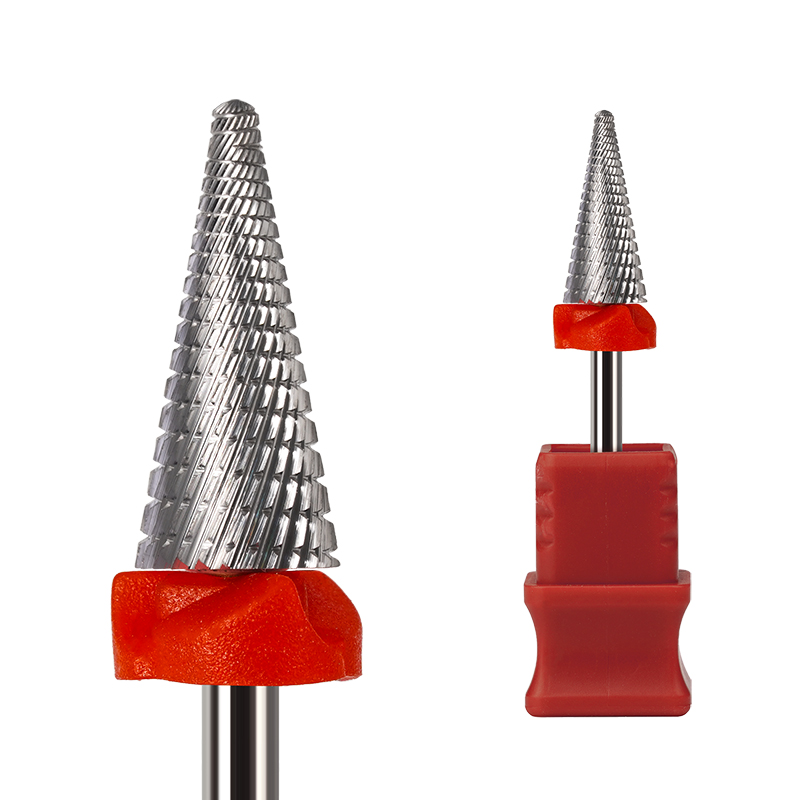
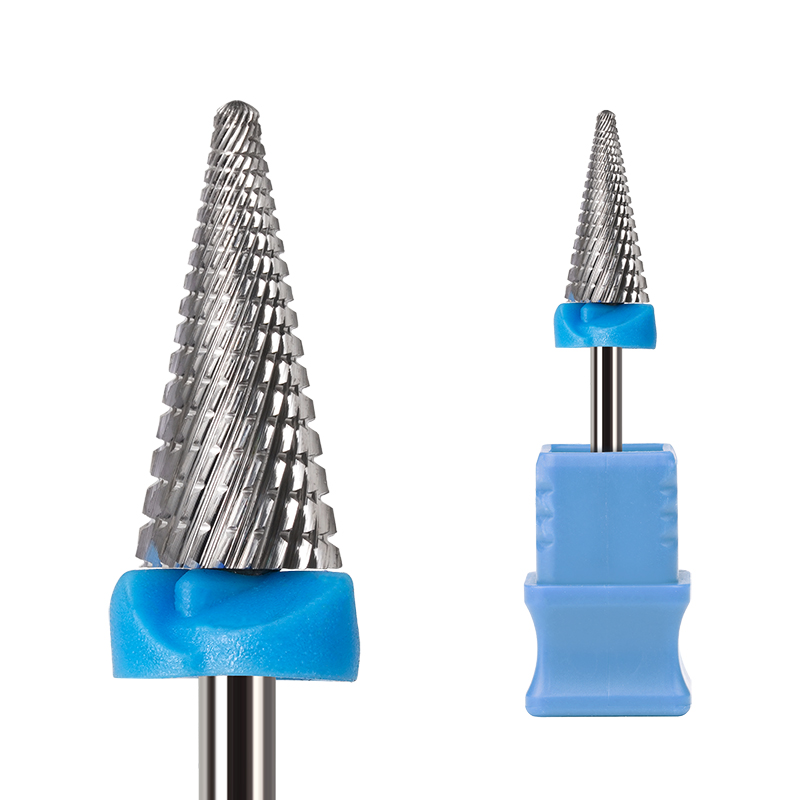
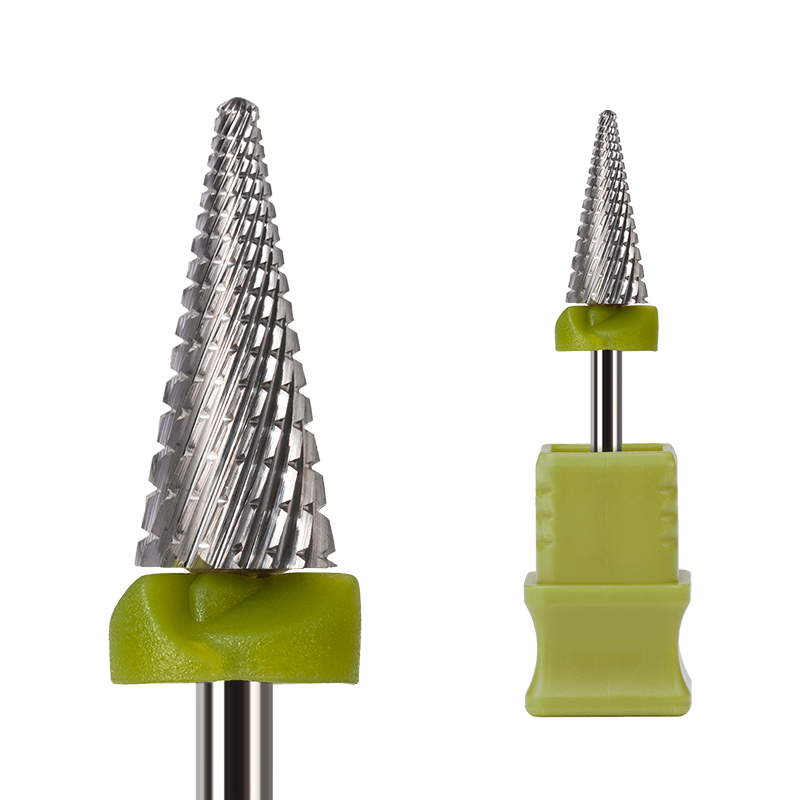
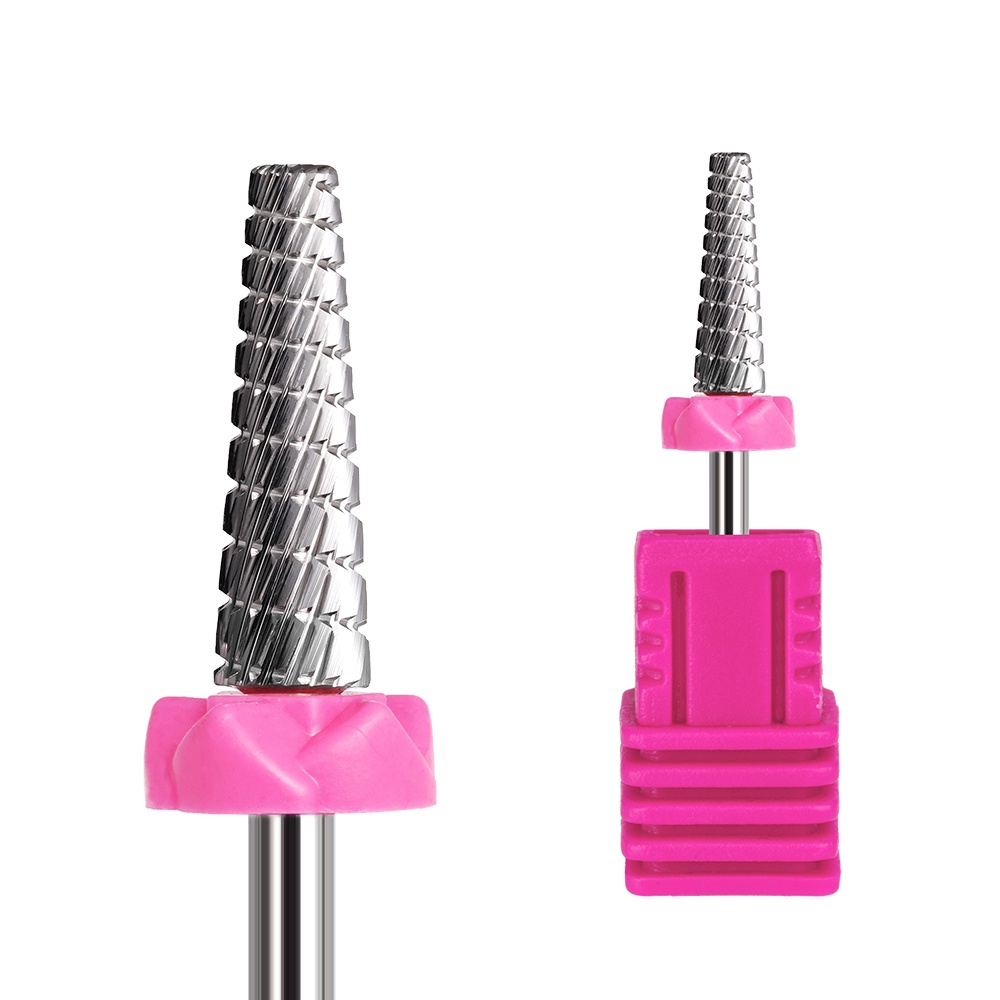
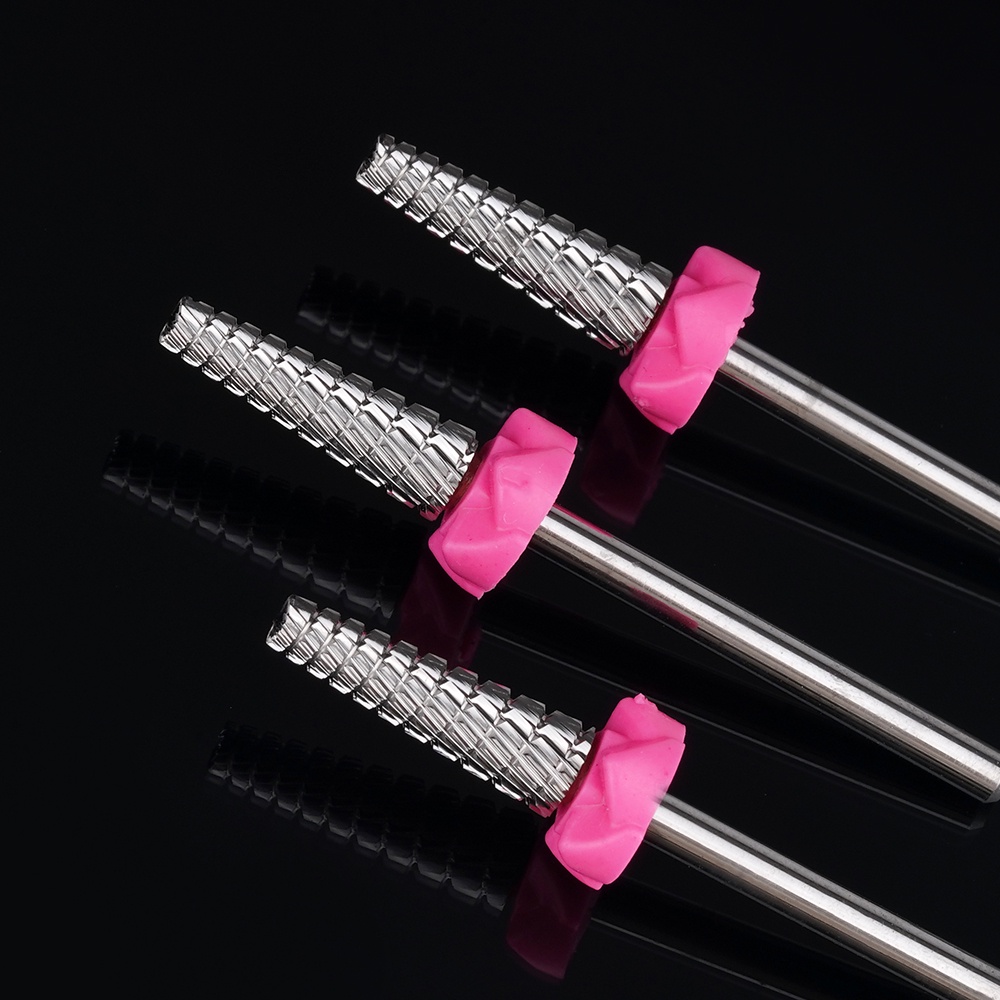
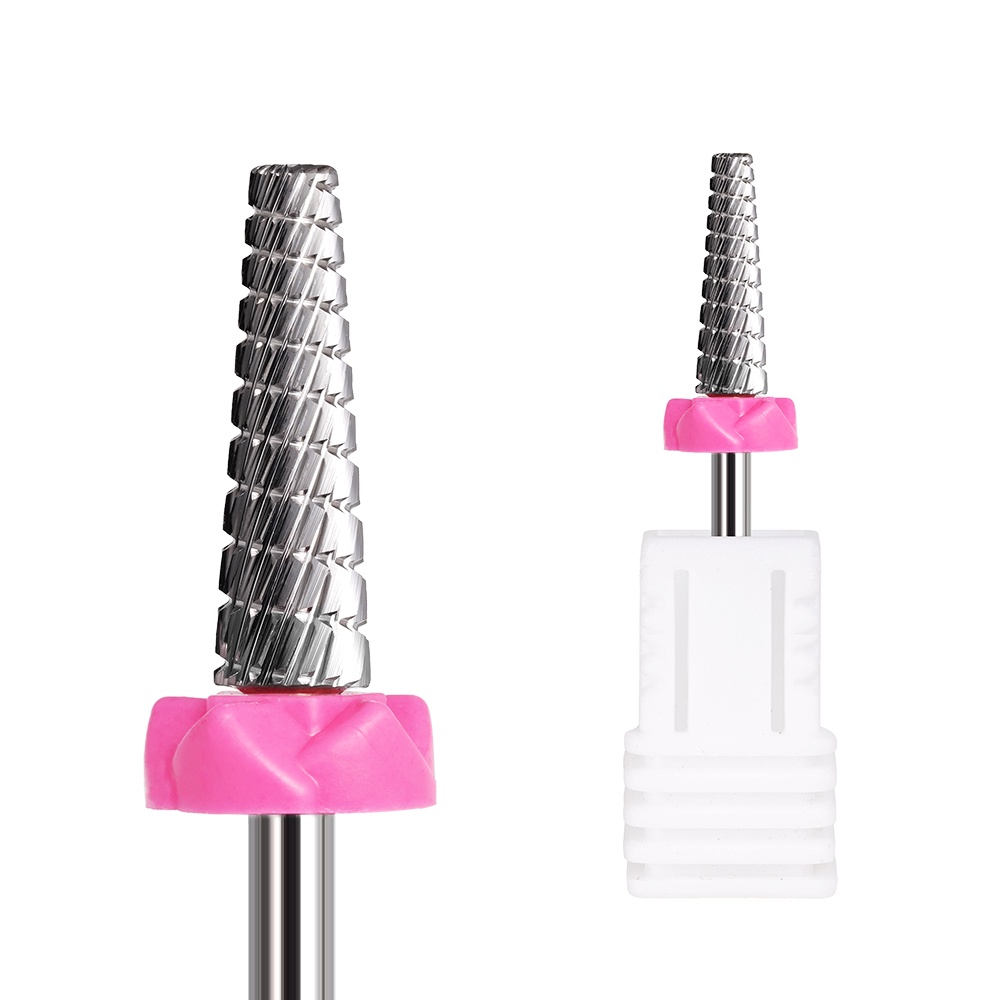
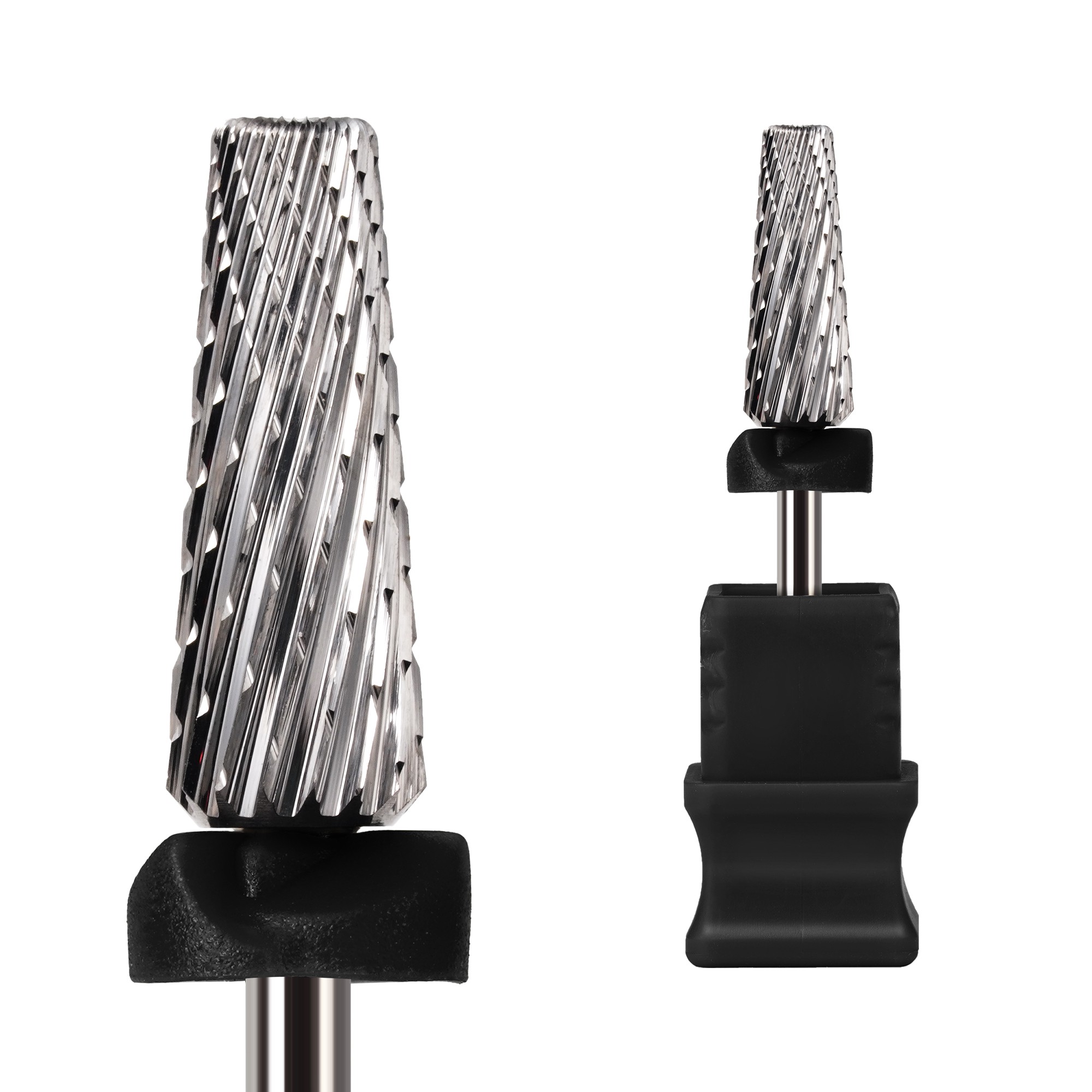
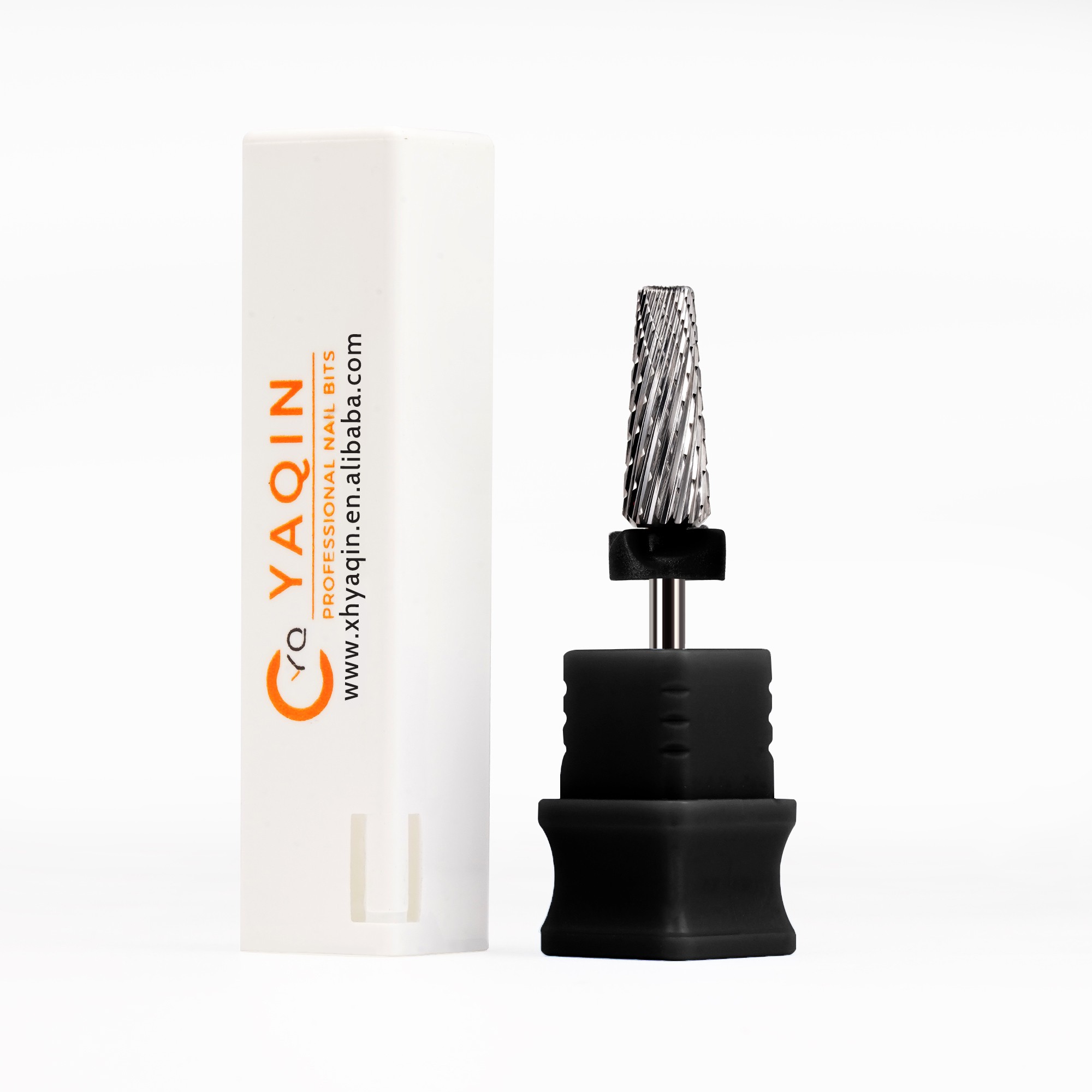
An example is the High Quality Helical Tungsten Carbide Nail Drill Bits 5 in 1 Professional Cross Cut Teeth Fast Remove Nail Gel Nail Drill Bit, which combines a multi-zone profile with cross-cut, helical cutting features. A “5 in 1” configuration may reduce bit changes by providing different working diameters or zones along one body. Its technical value should be judged by whether each zone has a clear, controllable function rather than by the number of claimed functions. The transition between zones must be smooth enough that it does not create an unexpected change in cutting behavior during a pass.
Shape affects heat management, but it does not determine heat alone
Heat is generated when cutting edges and work material resist motion. Shape influences heat by controlling contact area, chip clearance, and the likelihood of dwelling in one location. A wide bit can generate heat through prolonged broad contact; a narrow bit can generate heat through concentrated friction. Neither shape is inherently heat-free.
Several conditions deserve attention during evaluation:
- Cutting efficiency: A dull bit rubs rather than cuts. Shape cannot compensate for poor edge retention or damaged flutes.
- Flute clearance: When debris accumulates in the cutting pattern, removal becomes less efficient and friction can rise.
- Runout: A bit that does not rotate concentrically creates intermittent impact and uneven contact, reducing perceived control.
- Handpiece compatibility: The shank must match the collet specification and hold securely. A correct bit shape cannot offset unstable retention.
- Operating technique: Continuous movement, appropriate speed, and low deliberate pressure remain essential regardless of profile.
Claims that a particular shape “will not heat” or “cannot damage the natural nail” should be treated cautiously. These outcomes depend on the complete operating condition. A safety-top profile, for example, can reduce direct injury risk from a sharp terminal edge, but it does not prevent over-filing caused by excessive pressure, incorrect angle, excessive dwell time, or an unsuitable cut grade.
Assessing shape quality beyond a catalog silhouette
Technical evaluation should start with the physical geometry rather than the rendered outline in a product listing. Two nominally identical barrel or flame bits may differ in tip radius, maximum diameter, taper length, flute depth, and edge finishing. Each difference can alter filing control.
The tip should be inspected for consistent rounding where a safety-top design is specified. The flute pattern should continue evenly around the circumference without broken or heavily burred edges. On tapered profiles, the transition from body to tip should be symmetrical; asymmetry can lead to an uneven cutting path. Surface finish also matters because rough, uncontrolled finishing can retain debris and complicate cleaning.
Concentricity is especially important for narrow shapes. Even modest visible wobble at the tip changes the effective contact zone on every revolution. The result may be chatter, irregular cutting marks, reduced comfort, and unnecessary demand on the handpiece bearing system. A shape can be dimensionally correct yet functionally poor if it is not centered relative to the shank.
Material designation should also be examined carefully. “Tungsten carbide” describes the cutting material category but does not, by itself, establish flute accuracy, braze quality where applicable, balance, or durability in a specific use condition. Product acceptance criteria should define observable requirements: dimensional tolerance, tip finish, shank diameter and retention, rotational stability, tooth consistency, corrosion resistance after cleaning exposure, and packaging protection against edge damage.
Matching the profile to the filing task
The most reliable selection logic begins with the task, not with the most aggressive available bit. Broad enhancement reduction generally favors a barrel or tapered barrel with a profile that matches the nail’s curvature. Controlled refinement near narrowing areas favors a tapered section. Localized work around contours may justify a flame or cone. Very narrow profiles should remain limited to detail work for which their access advantage outweighs their reduced error tolerance.
Cut grade should then be matched to the product material and the amount of removal required. A coarse cutting pattern can be productive for bulk reduction of hard enhancement material, but it is not a finishing tool. A finer pattern can support surface refinement, though it may become inefficient if used for large-volume removal. Shape and cut grade must be specified together because neither communicates filing behavior adequately on its own.
For multi-purpose bits, the critical question is whether the working zones are clearly distinguishable in use. If a single profile is intended to remove bulk product, approach sidewalls, refine transitions, and work near the cuticle area, the operator must be able to identify where one functional zone ends and another begins. Otherwise, versatility can become inconsistency.
The practical control principle
A carbide nail drill bit shape affects filing control by defining the physical margin between efficient removal and unintended contact. Wide, stable profiles improve coverage and support even reduction. Tapers add positional flexibility but require more deliberate angle management. Flame, cone, and needle forms improve access and visibility in restricted areas, while reducing the tolerance for error. Tip geometry, flute pattern, balance, and cut condition determine whether that theoretical shape control is delivered consistently in operation.
Shape selection is therefore not a matter of choosing the most versatile-looking profile. It is the process of matching contact geometry to a specific removal task, material thickness, surface curvature, and safety boundary. When those conditions are specified clearly, the performance of a carbide nail drill bit becomes easier to evaluate, compare, and control.
News List
- Preventing Gouges and Uneven Filing With Small Barrel Nail Drill BitsSep 20, 2026
- How Diameter and Grit Affect Small Barrel Nail Drill Bit PerformanceSep 20, 2026
- Can Hytos Nail Drill Bits Be Used Safely on Natural Nails and Gel Polish?Sep 20, 2026
- How to Verify Fit Between Hytos Nail Drill Bits and an E-File HandpieceSep 20, 2026
- Safe Speed Settings for Umbrella Nail Drill Bits Around the Nail FoldSep 20, 2026
- Umbrella vs Flame Nail Drill Bits: Which Shape Offers Better Cuticle Control?Sep 20, 2026
Best-Selling Products
 Cross Cut Safety Stainless Steel Tungsten Carbide Nail Drill Bits Salon Foot Use XF-C Grit for Removing Nails
 First-rate Quality Tungsten Carbide Nail Drill Bits Best Coating Manicure Remove Gel Nails Accessories
 Professional Advanced Safety Cuticle Bits Two-Way Rotate 3/32'' Carbide Tungsten 5 in 1 Nail Drill Bits
 Wholesale 5 in 1 Electric Manicure Nail Drill Bits Various Coating Cone Cuticle Bit with Rotary Cross Cut for Nail Art
 New Slant Tooth Tungsten Steel Nail Drill Bits Dead Skin Removal 5-in-1 Universal Grinding Nail Polish Head Tool Nail Drill Bits
 4.0mm Small 5 in 1 Integrated Sharpe Tungsten Nail Drill Bit Straight Teeth Gel Polish Removal
 Flame Sharp XF F M C XC Silver Safety Professional Corn Tungsten Carbide Nail Bit for Drill Machine Accessories
 Factory Direct 5 in 1 Tungsten Carbide Nail Drill Bits 6.8MM Cross Cut Safety Manicure 5 in 1 Nail Drill Bits
Please give us a message