
How Diamond Nail Drill Bits Work: Grit, Coating, and Cutting Action
How Diamond Nail Drill Bits Work: Grit, Coating, and Cutting Action
A diamond nail drill bit delivers controlled abrasion rather than the aggressive chip-forming action associated with fluted carbide cutters. Its working surface is covered with industrial diamond particles held in a metal bond, creating thousands of microscopic cutting points. When the rotating bit contacts gel, acrylic, callused skin, or the nail surface, those points wear material away in fine increments.
For a technical evaluator, this simple description is not enough. Two bits may share the same barrel shape and grit label yet behave very differently in service. Removal rate, vibration, heat at the contact zone, dust character, finish quality, and usable life all depend on the relationship between diamond grit, bonding or coating quality, substrate geometry, and operating conditions.
The key is to assess a diamond abrasive bit as a system. The abrasive particles must be sharp enough to engage the workpiece, sufficiently exposed to cut rather than rub, and securely retained as the tool is cleaned and repeatedly used. The bit body must run concentrically in the handpiece. Meanwhile, the operator must pair the selected grit with a speed, pressure, and application appropriate to the material being removed.
What Actually Happens at the Cutting Surface?
Despite the word “cutting,” a diamond-coated bit usually works through micro-abrasion. Each exposed diamond grain behaves like a tiny, irregular cutting edge. As the bit rotates, individual grains penetrate the surface slightly, fracture or scratch the coating being removed, and produce very small particles of dust. Material removal occurs across a broad field of contact rather than along a small number of machined flutes.
This is why diamond bits are valued for controlled refining work. On natural nail plates, around the cuticle area, on sidewalls, and during finish smoothing, the distributed abrasive action can feel more predictable than a highly aggressive cutter. The same characteristic can become a limitation when a large volume of thick hard gel or acrylic must be removed quickly: the abrasive surface may load up or generate unnecessary friction if its grit and geometry are not matched to the task.
At the interface between bit and nail enhancement, three outcomes compete:
- Effective cutting: exposed diamond particles remove material with limited pressure.
- Rubbing: dull, clogged, or poorly exposed particles slide across the surface, increasing heat without proportional removal.
- Loading: softened product dust fills the spaces between abrasive grains, reducing active cutting points.
A reliable evaluation should therefore look beyond whether a bit “feels rough.” Roughness alone does not confirm efficient cutting action. A properly engineered surface removes material steadily, leaves a reasonably uniform scratch pattern for its grit class, and avoids sudden grabbing or excessive heat when used within normal operating parameters.
Grit Size Sets the Balance Between Removal and Finish
Grit describes the approximate size and density of the diamond particles on the working surface. In practical terms, coarse grit has larger, more prominent particles and more space between active points. Fine grit has smaller particles, producing shallower scratches and a smoother finish. Grit naming is not perfectly standardized across every supplier, so technical teams should ask for the supplier’s defined grit range or verify performance through internal testing rather than relying on labels alone.
A coarse diamond nail drill bit should not simply be judged as “better” because it removes material faster in a short test. Its larger abrasive features can leave deeper grooves and require more subsequent refining. Conversely, an ultra-fine bit can appear safe in a brief demonstration but may demand more contact time, which raises the risk of heat through prolonged friction. The appropriate grit is the one that reaches the desired surface condition with the lowest reasonable combination of time, pressure, and thermal load.
For evaluators comparing product ranges, grit consistency matters as much as grit selection. If two medium bits from the same shipment perform noticeably differently, the issue may lie in particle grading, distribution density, plating thickness, or incomplete process control. Consistent grit behavior supports repeatable technician technique and makes product training more credible.
Coating Quality Is More Than a Decorative Surface
The term “diamond coating” is often used broadly, but the retention method determines whether the abrasive layer remains useful after repeated cleaning cycles. In many professional nail bits, diamonds are electroplated onto a metal body, commonly stainless steel. During plating, metal is deposited around the diamond particles to anchor them in place while leaving enough of each grain exposed to cut.
A well-controlled coating needs a careful compromise. If too much of each particle is buried, the bit feels smooth and tends to rub rather than abrade. If particles are insufficiently embedded, they may shed early, leaving bare zones and reducing tool life. Uneven deposition can also create patches with very different aggressiveness around the circumference.
Technical inspection can reveal several practical indicators:
- Uniform abrasive coverage: the working area should not show obvious thin spots, blank areas, or inconsistent bands.
- Particle retention: after normal cleaning and test use, the surface should retain its cutting character without rapid smoothing.
- Controlled exposure: diamond particles should be visibly present rather than submerged beneath an overly thick metal layer.
- Corrosion resistance: the bit should tolerate intended cleaning and disinfection procedures without rust or coating breakdown.
- Stable shank and concentricity: even an excellent abrasive layer performs poorly if the bit wobbles in the handpiece.
Coating adhesion becomes especially important in high-volume salon environments, where tools are repeatedly cleaned, handled, and exposed to moisture. Wuxi Yaqin Trading Co., Ltd. applies quality controls from raw-material purchasing through production and packing, an approach that is relevant here because abrasive performance can be compromised at several stages long before a bit reaches the technician. ISO9001:2000 quality management certification also provides a process framework, although product-specific verification remains essential for every purchasing program.
Why Heat Develops—and Why Speed Alone Is Not the Cause
Heat is the most common concern in powered nail filing, yet it is often attributed only to RPM. Rotational speed is important, but the actual thermal result depends on friction, contact area, pressure, abrasive sharpness, and dwell time. A bit that is dull or loaded with product can feel hot even at a conservative speed because it is sliding rather than cutting.
Heat rises quickly when the operator holds a rotating bit in one position, presses hard to compensate for a slow-cutting surface, or uses a fine grit for a job requiring a more open and aggressive abrasive. Large-diameter barrel profiles can also create more contact area than tapered or narrow profiles. In practice, light pressure and continuous movement usually matter as much as the speed setting.
Material type changes the equation. Soft gel may soften and smear into the abrasive surface, while hard gel and acrylic demand enough cutting efficiency to avoid prolonged contact. A diamond bit is often selected for refining, surface preparation, and controlled cleanup, while a carbide bit is frequently more suitable for rapid bulk gel removal because its machined flutes evacuate larger chips.
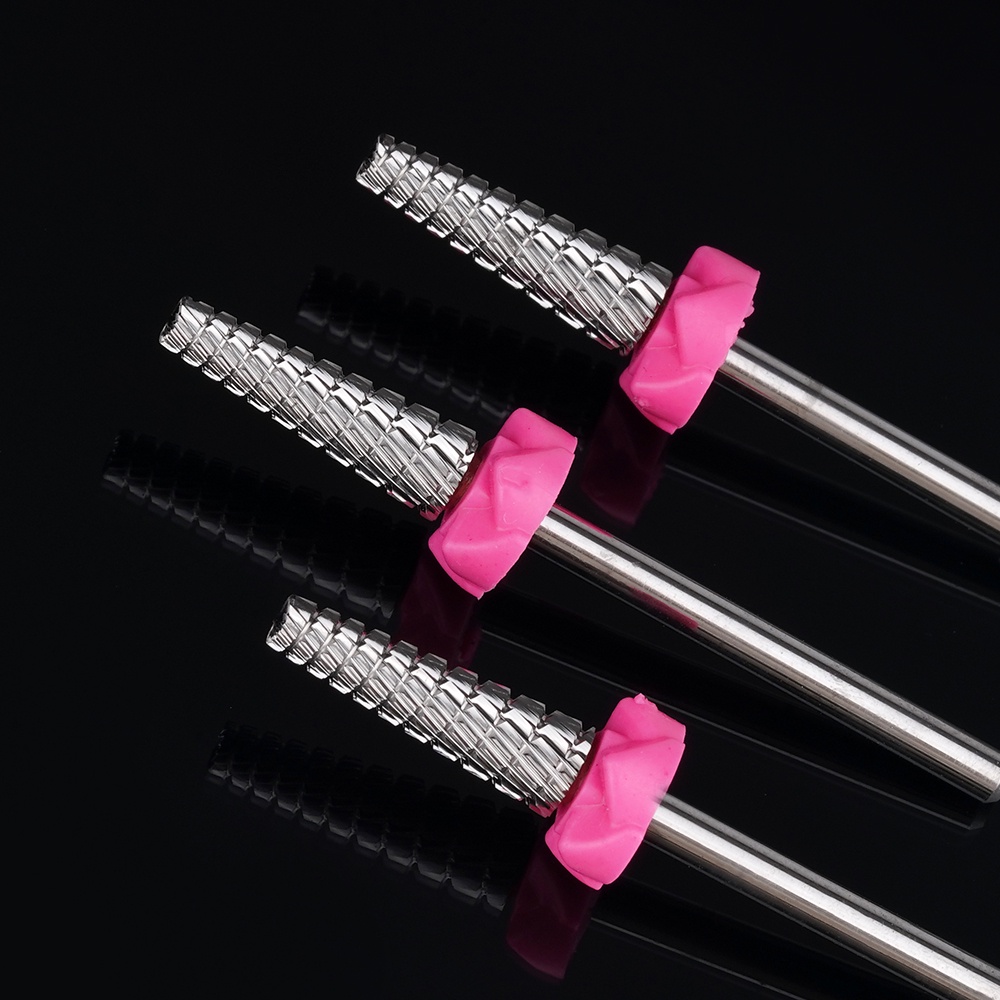
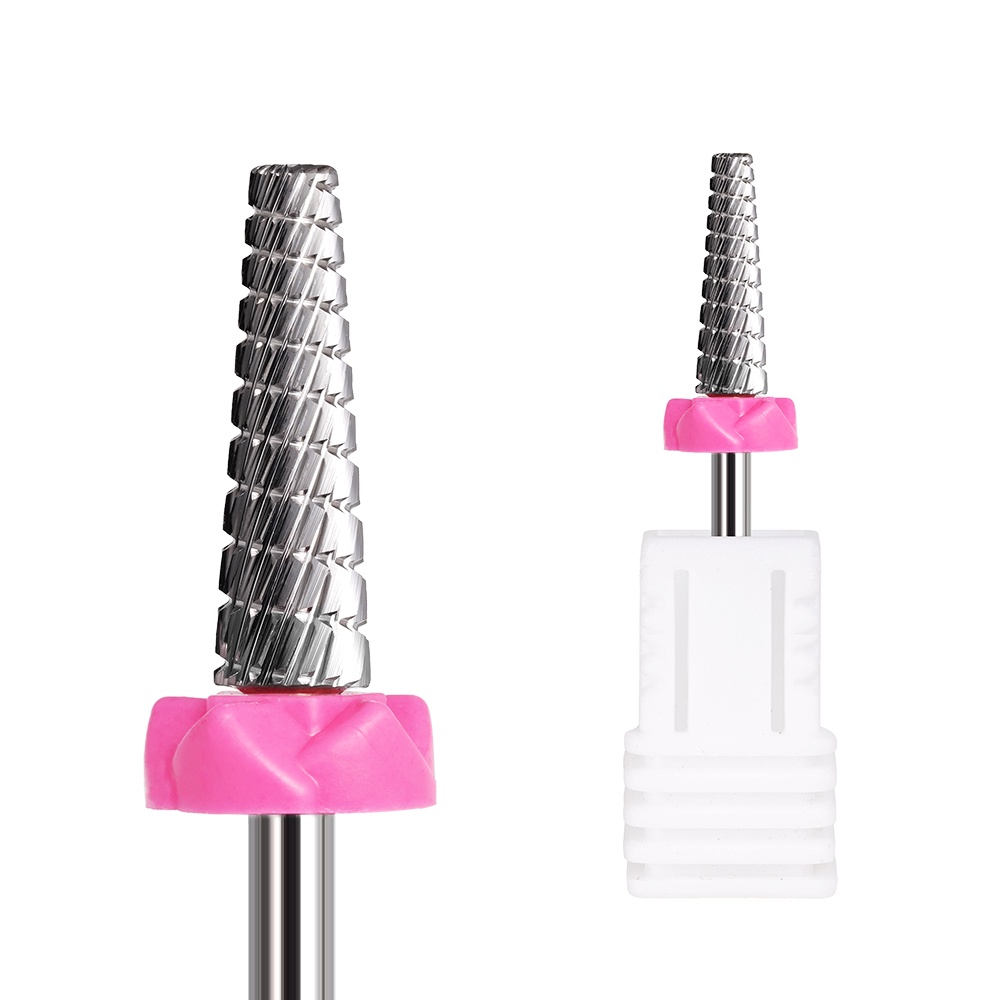
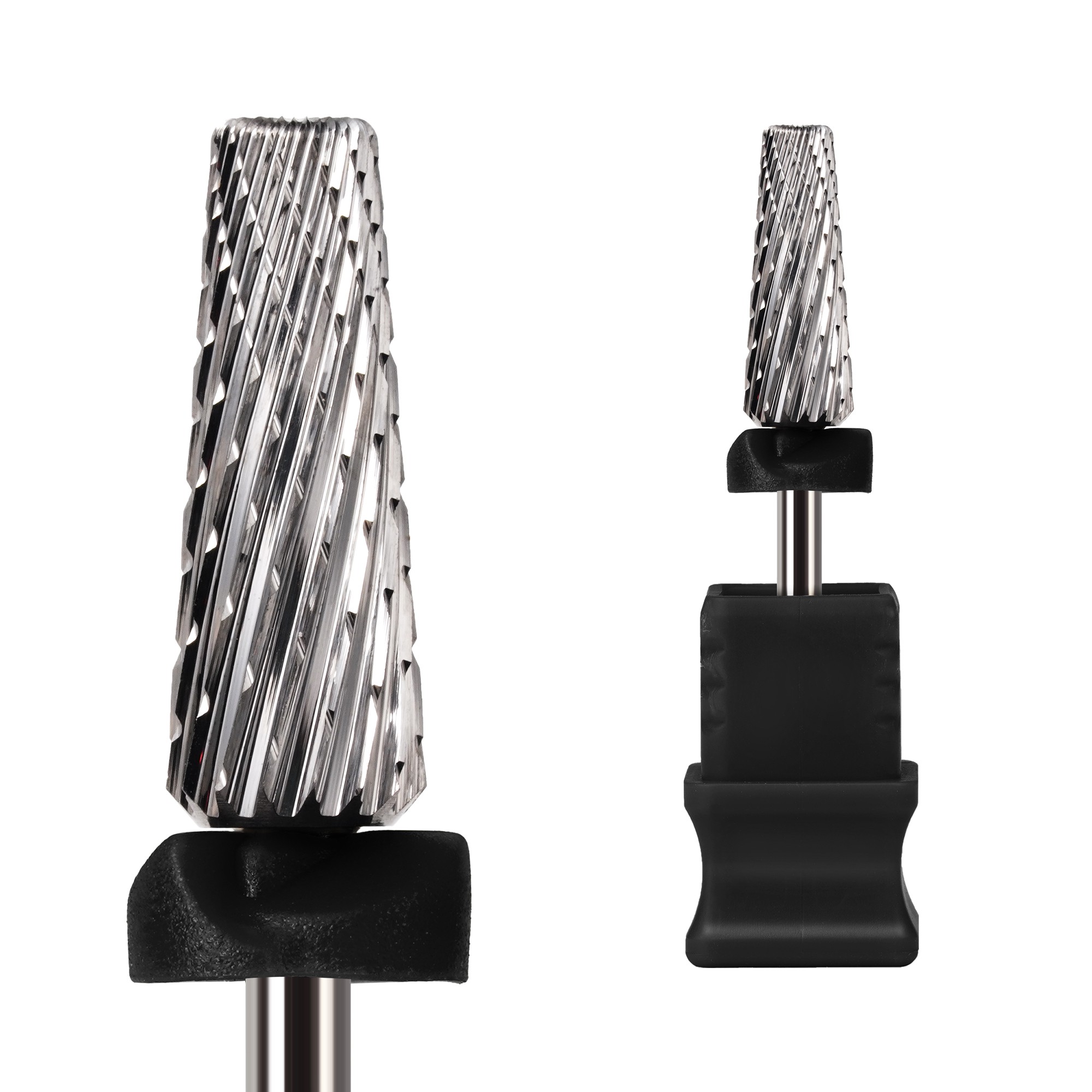
This distinction is useful when reviewing mixed bit sets. For example, a tungsten-steel carbide option such as the Nail Supplier Manicure Art Carbide Drill Bits Set Sharp 5XC Nail Drill Bit Tungsten Drill Bits for Nail Gel Cuticle Take Off is designed around fluted cutting geometry rather than diamond abrasion. Its recommended operating ranges—15,000–20,000 RPM for hard gel removal and 10,000–15,000 RPM for soft or base gel removal—illustrate how bit material, geometry, and application must be assessed together. A rounded tip can add a margin of safety near skin, but it does not eliminate the need for correct speed, movement, and operator control.
Geometry Changes How a Diamond Bit Feels in Use
The abrasive layer may receive most of the attention, but body shape affects access, contact pressure, and visibility. A barrel bit presents a broad, stable surface for leveling and smoothing. A tapered cone reaches sidewalls and narrower areas. A flame or needle profile is intended for precision work around the cuticle zone, where visibility and gentle contact matter more than high removal volume.
Narrow bits are useful when working around smaller nails or confined contours, while wider working surfaces can reduce passes across average to larger nail plates. Neither geometry is inherently superior. The relevant question is whether the chosen profile gives the operator enough control to maintain a shallow, moving contact without touching adjacent skin or thinning the natural nail.
Edge design deserves inspection as well. A sharp, abrupt transition at the end of a diamond-coated section may be effective for certain detailing tasks, but it increases the consequence of a handling error. Rounded transitions and carefully finished tips are often preferable where the tool is likely to approach skin. Technical evaluators should assess the full tool, including the transition from shank to working head, rather than judging only the visible abrasive area.
A Practical Evaluation Protocol for Diamond Nail Drill Bits
Short bench tests can be misleading. A bit that looks bright and cuts quickly for a minute may lose effectiveness after cleaning, while another with a less dramatic initial feel may provide more stable results over repeated cycles. A more useful evaluation combines dimensional inspection, controlled use, and post-use review.
- Confirm fit and runout. Insert the bit into the intended handpiece and observe rotation at low and working speeds. Noticeable wobble can cause uneven finish, vibration, and operator fatigue.
- Inspect surface distribution. Under magnification, check for uniform diamond coverage, exposed particles, smooth plating transitions, and no obvious bare patches.
- Test on representative materials. Use the gel, acrylic, or practice substrate that reflects the intended application. Testing only on one material can hide loading or heat problems.
- Record removal behavior. Note the pressure needed, number of passes, dust evacuation, surface scratch pattern, and whether the tool grabs.
- Evaluate temperature subjectively and consistently. Compare bits under the same speed, time, and operator method. The goal is comparative control, not an unsupported absolute claim.
- Clean and retest. Reassess abrasive retention and cutting after the cleaning procedure expected in service.
For procurement teams, it is also sensible to evaluate batch traceability, packaging protection, and communication of use guidance. A protective cap, for example, does not change cutting performance, but it can reduce accidental damage to the working surface during storage and transport. Clear separation of diamond abrasive bits from carbide cutters in product documentation helps prevent incorrect application by end users.
Common Misreadings During Specification Review
One frequent mistake is assuming that a diamond-coated bit is universally gentler than a carbide bit. It can be gentler in the right grit and application, but a coarse diamond surface used with pressure can still damage the natural nail or irritate skin. Another is equating a shiny coating with durability. Visual appearance offers only limited evidence; retention after realistic use is what matters.
It is also risky to compare RPM recommendations without considering bit diameter and cutting mechanism. A speed appropriate for a narrow diamond flame bit may not be appropriate for a wide barrel or a fluted tungsten carbide bit. Finally, “no overheating” should not be treated as an intrinsic product guarantee. Heat management is a combined result of tool condition, material, handpiece performance, speed, pressure, and technician technique.
Making a Sound Selection
A diamond nail drill bit should be selected for the specific level of abrasion and access required, not as a generic substitute for every filing task. Fine and medium diamond profiles are often effective where surface control, cuticle-area precision, and finish quality are priorities. For fast reduction of thick enhancements, a correctly chosen carbide tool may be the more technically efficient choice, followed by diamond refinement where needed.
The strongest products show consistency: stable shank dimensions, even abrasive coverage, reliable particle retention, sensible profile design, and clear application guidance. When those factors align, the bit does not need excessive pressure to prove its value. It simply removes material predictably, leaves the intended surface condition, and gives technicians the confidence to work with control rather than force.
News List
- Preventing Gouges and Uneven Filing With Small Barrel Nail Drill BitsSep 20, 2026
- How Diameter and Grit Affect Small Barrel Nail Drill Bit PerformanceSep 20, 2026
- Can Hytos Nail Drill Bits Be Used Safely on Natural Nails and Gel Polish?Sep 20, 2026
- How to Verify Fit Between Hytos Nail Drill Bits and an E-File HandpieceSep 20, 2026
- Safe Speed Settings for Umbrella Nail Drill Bits Around the Nail FoldSep 20, 2026
- Umbrella vs Flame Nail Drill Bits: Which Shape Offers Better Cuticle Control?Sep 20, 2026
Best-Selling Products
 Cross Cut Safety Stainless Steel Tungsten Carbide Nail Drill Bits Salon Foot Use XF-C Grit for Removing Nails
 First-rate Quality Tungsten Carbide Nail Drill Bits Best Coating Manicure Remove Gel Nails Accessories
 Professional Advanced Safety Cuticle Bits Two-Way Rotate 3/32'' Carbide Tungsten 5 in 1 Nail Drill Bits
 Wholesale 5 in 1 Electric Manicure Nail Drill Bits Various Coating Cone Cuticle Bit with Rotary Cross Cut for Nail Art
 New Slant Tooth Tungsten Steel Nail Drill Bits Dead Skin Removal 5-in-1 Universal Grinding Nail Polish Head Tool Nail Drill Bits
 4.0mm Small 5 in 1 Integrated Sharpe Tungsten Nail Drill Bit Straight Teeth Gel Polish Removal
 Flame Sharp XF F M C XC Silver Safety Professional Corn Tungsten Carbide Nail Bit for Drill Machine Accessories
 Factory Direct 5 in 1 Tungsten Carbide Nail Drill Bits 6.8MM Cross Cut Safety Manicure 5 in 1 Nail Drill Bits
Please give us a message