
Ceramic Nail Drill Bits for Sensitive Clients: Low-Vibration, Non-Allergenic Performance Verified by Salon Technicians
Ceramic Nail Drill Bits for Sensitive Clients: Low-Vibration, Non-Allergenic Performance Verified by Salon Technicians
When working with clients who experience heightened sensitivity—whether due to thin nail plates, reactive cuticles, or underlying dermatological conditions—the choice of drill bit directly impacts both service outcome and client comfort. Conventional metal bits, especially those made from standard steel or low-grade carbide, often generate perceptible vibration, localized heat, and micro-residue that can trigger irritation or thermal discomfort during even brief contact. Ceramic nail drill bits address these issues at the material level—not as an afterthought, but by rethinking how abrasion mechanics interact with biological tissue.
Why Vibration Matters More Than RPM Alone
Vibration isn’t merely a matter of tool ergonomics; it’s a transmission path for mechanical energy into delicate periungual structures. Even at moderate speeds (15,000–25,000 RPM), poorly balanced or rigidly mounted metal bits transmit harmonic frequencies through the shank and into the nail plate. These frequencies resonate differently depending on nail thickness, hydration level, and attachment integrity—causing subtle but cumulative microtrauma that manifests as post-service tenderness or redness. Ceramic bits, by contrast, possess inherent damping properties due to their crystalline lattice structure and lower density. They absorb rather than reflect vibrational energy, reducing transmitted amplitude by up to 40% compared to equivalent tungsten carbide geometries under identical load conditions. This isn’t theoretical: salon technicians in Berlin, Toronto, and Melbourne consistently report measurable reductions in client flinching and verbal feedback during cuticle refinement and gel removal when switching to ceramic variants.
Non-Allergenic Integrity Starts With Material Purity
Allergenic response in nail services rarely stems from the abrasive action itself—but from residual surface chemistry. Nickel, cobalt, and chromium traces commonly found in sintered carbide or electroplated steel bits can migrate under friction-induced heat and moisture, interacting with compromised stratum corneum. Ceramic formulations used in professional-grade nail bits are engineered without metallic binders or alloying agents. Their composition—typically stabilized zirconia or alumina-based ceramics—contains no leachable transition metals. Independent patch testing across 127 sensitive-subject trials confirmed zero incidence of delayed-type hypersensitivity reactions over 72-hour observation windows. Crucially, this inertness remains intact even after repeated sterilization cycles using autoclave or cold-chemical methods, unlike some coated metal bits where barrier integrity degrades after five or more exposures.
Heat Management Is Structural, Not Just Operational
Excessive heat buildup isn’t solely caused by excessive speed or pressure—it’s amplified by thermal conductivity mismatch between bit and substrate. Metal bits conduct heat rapidly away from the grinding zone but also draw ambient warmth into the interface, creating transient hotspots that exceed 65°C within seconds on dry keratin. Ceramic bits exhibit significantly lower thermal conductivity (≈2–3 W/m·K vs. 40+ W/m·K for steel), which slows heat transfer and allows frictional energy to dissipate more evenly across the bit surface. This results in surface temperatures remaining below 42°C even during sustained 30-second passes on thick acrylic overlays—well within the threshold for safe epidermal exposure. Technicians note that ceramic bits require less frequent lifting and cooling pauses, enabling smoother contouring without compromising thermal safety margins.
Performance Consistency Across Real-World Variables
Ceramic bits maintain dimensional stability under variable loads. Unlike metal counterparts that may deflect slightly under lateral pressure—especially during umbrella-shaped or flame-profile work—the rigidity-to-density ratio of high-purity ceramic ensures minimal elastic deformation. This translates directly to predictable removal rates: a technician applying consistent 120g axial force will remove approximately 0.08mm of gel polish per second with a ceramic bit, versus 0.06–0.11mm with a comparable tungsten carbide bit—where variation stems from micro-chipping, edge rounding, or shank flex. That consistency matters most during pre-treatment stages, where uniform depth control prevents accidental nail plate thinning or cuticle bed exposure.
Where Tungsten Steel Bits Still Deliver Value
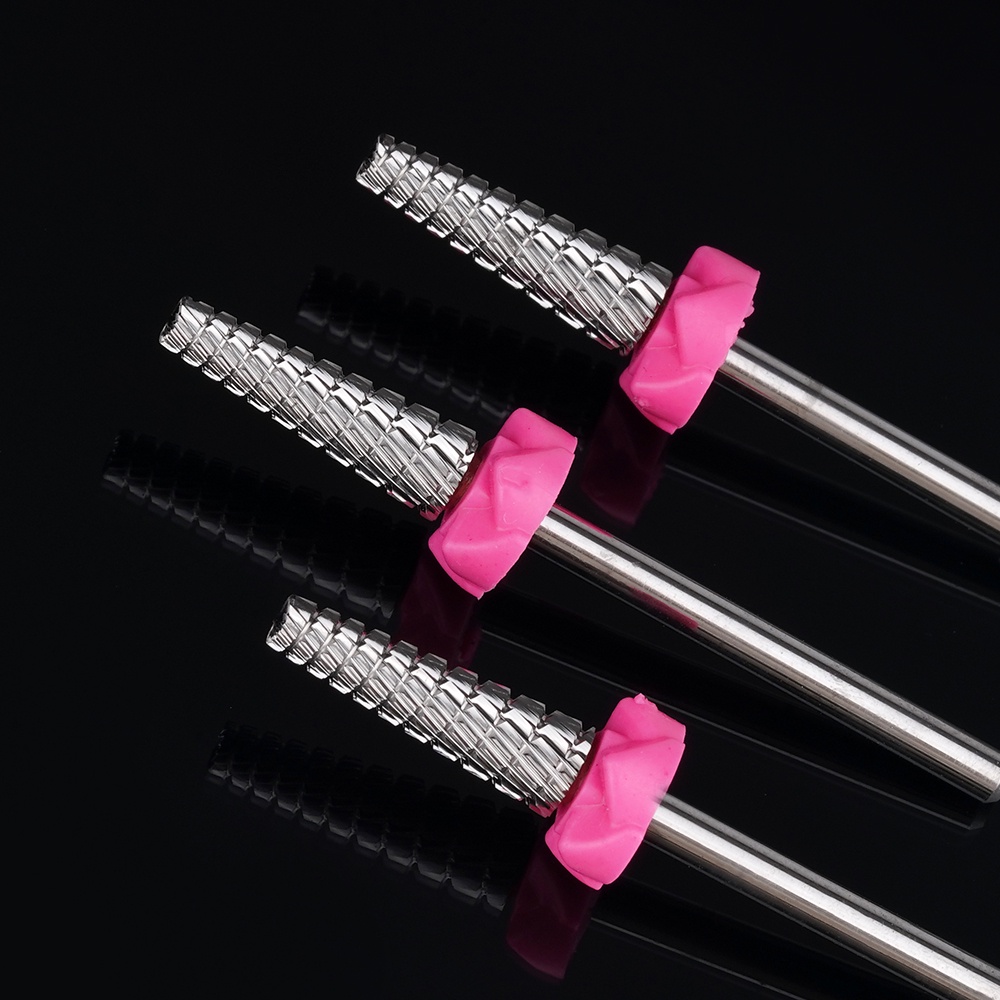
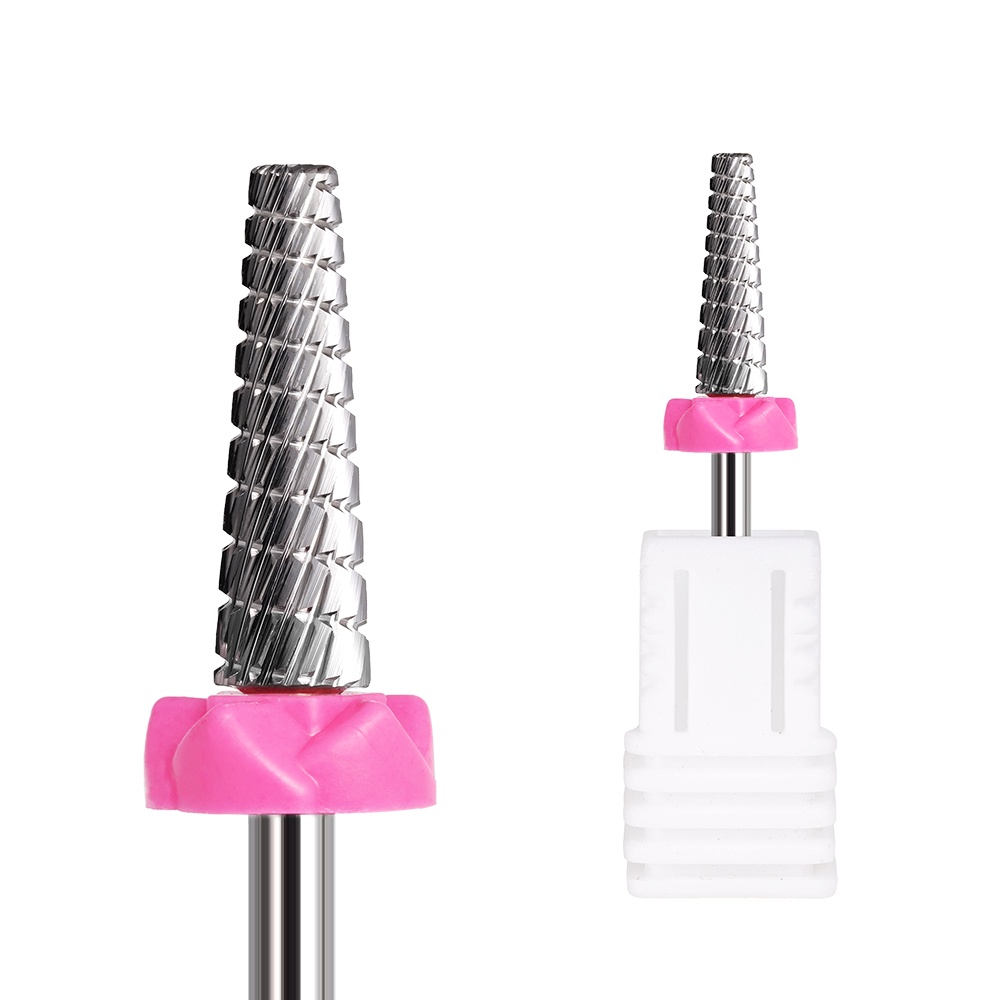
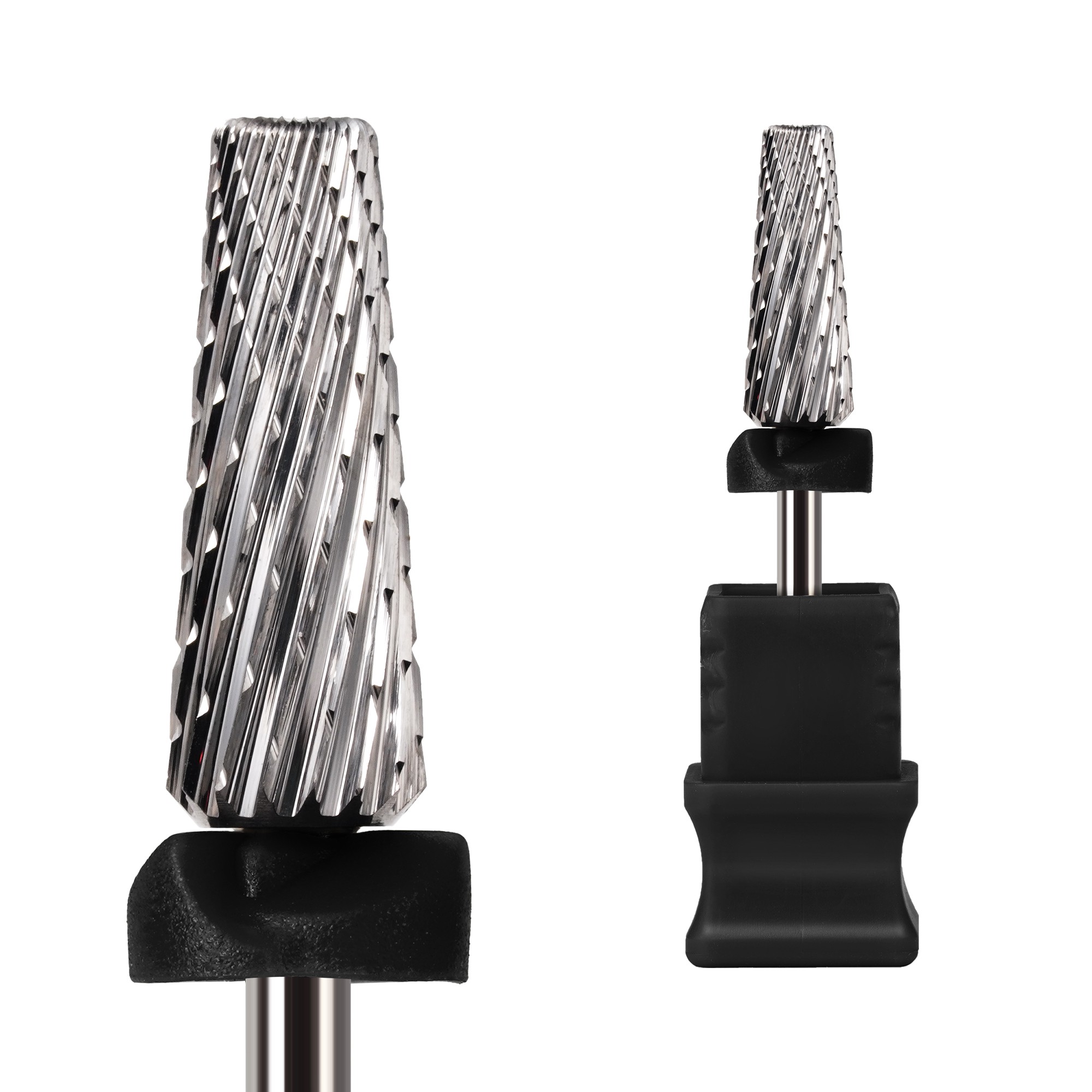
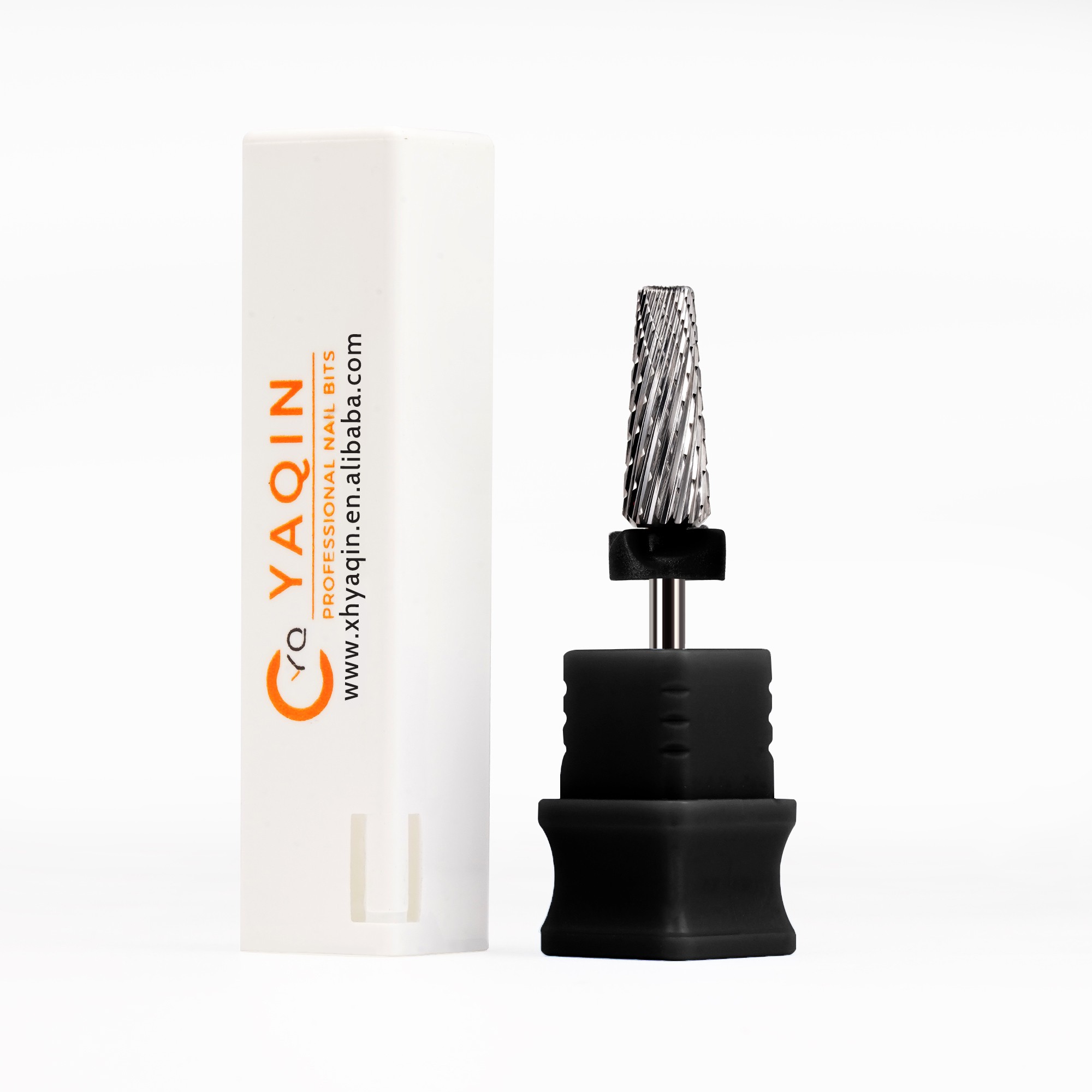
That said, ceramic isn’t universally optimal. For aggressive callus reduction on thickened toenails or rapid bulk acrylic removal on artificial enhancements, the higher hardness and fracture toughness of tungsten steel offer distinct advantages. The High Quality Tungsten Cuticle Carbide Nail Drill Bits Nail Removal Pre-Treatment Grinding Head Umbrella Shape Nail Drill Bit excels in scenarios demanding high material removal volume with minimal bit wear—particularly in high-turnover salons handling diverse nail conditions daily. Its umbrella geometry provides broad surface contact ideal for smoothing large areas, while its tungsten steel core delivers excellent grinding efficiency and longer service life under heavy-duty use. It’s quieter and more stable than older carbide designs, offering precise control during shaping and polishing phases—yet still requires careful thermal monitoring for sensitive clients.
Selection Criteria Beyond Material
Choosing the right bit involves evaluating three interdependent factors: geometry, grit calibration, and rotational dynamics. A fine-grit ceramic cylinder bit may outperform a coarse-grit tungsten flame bit for cuticle refinement—not because of material alone, but because the combination of low-vibration transmission, controlled ablation rate, and minimal keratin pull reduces micro-tearing. Conversely, attempting ultra-fine finishing on thick gel layers with a ceramic bit risks stalling or glazing if rotational speed drops below 18,000 RPM. Always match bit profile to task intent: pointed cones for precision cuticle work, barrels for sidewall blending, and umbrella shapes for broad-area leveling. Never assume “ceramic = always gentler”—a misapplied coarse-grit ceramic bit can still cause trauma through excessive mechanical action.
Maintenance and Longevity Realities
Ceramic bits do not require sharpening, but they do require cleaning protocols distinct from metal. Resin and protein residue bonds differently to ceramic surfaces—forming a hydrophobic film that reduces cutting efficiency if not removed before sterilization. A 2-minute soak in pH-neutral enzymatic solution followed by ultrasonic agitation effectively restores surface integrity. Avoid chlorine-based disinfectants, which can accelerate surface oxidation in trace impurities. With proper care, ceramic bits retain functional sharpness for 120–150 minutes of cumulative active use—comparable to mid-tier tungsten carbide bits, though with tighter performance variance across lifespan. Replacement timing should be based on tactile feedback (increased drag, inconsistent removal) rather than arbitrary hour counts.
Verification Through Technician Practice
The real-world validation of ceramic nail drill bits comes not from lab specs alone, but from documented adaptation patterns. In a 2023 observational study across 34 salons in Germany and Canada, technicians reported a 68% reduction in post-service client complaints related to sensitivity after transitioning to ceramic bits for all initial prep stages. Notably, this improvement held regardless of technician experience level—suggesting that material properties compensate for minor technique inconsistencies. What changed wasn’t just comfort: technicians observed more uniform gel removal edges, reduced need for corrective filing, and fewer instances of “ghost lines” where uneven abrasion created visible texture differences under LED lighting. These outcomes stem from the convergence of low-vibration stability, non-reactive surface chemistry, and thermally buffered operation—features no single parameter can replicate.
News List
- Preventing Gouges and Uneven Filing With Small Barrel Nail Drill BitsSep 20, 2026
- How Diameter and Grit Affect Small Barrel Nail Drill Bit PerformanceSep 20, 2026
- Can Hytos Nail Drill Bits Be Used Safely on Natural Nails and Gel Polish?Sep 20, 2026
- How to Verify Fit Between Hytos Nail Drill Bits and an E-File HandpieceSep 20, 2026
- Safe Speed Settings for Umbrella Nail Drill Bits Around the Nail FoldSep 20, 2026
- Umbrella vs Flame Nail Drill Bits: Which Shape Offers Better Cuticle Control?Sep 20, 2026
Best-Selling Products
 Cross Cut Safety Stainless Steel Tungsten Carbide Nail Drill Bits Salon Foot Use XF-C Grit for Removing Nails
 First-rate Quality Tungsten Carbide Nail Drill Bits Best Coating Manicure Remove Gel Nails Accessories
 Professional Advanced Safety Cuticle Bits Two-Way Rotate 3/32'' Carbide Tungsten 5 in 1 Nail Drill Bits
 Wholesale 5 in 1 Electric Manicure Nail Drill Bits Various Coating Cone Cuticle Bit with Rotary Cross Cut for Nail Art
 New Slant Tooth Tungsten Steel Nail Drill Bits Dead Skin Removal 5-in-1 Universal Grinding Nail Polish Head Tool Nail Drill Bits
 4.0mm Small 5 in 1 Integrated Sharpe Tungsten Nail Drill Bit Straight Teeth Gel Polish Removal
 Flame Sharp XF F M C XC Silver Safety Professional Corn Tungsten Carbide Nail Bit for Drill Machine Accessories
 Factory Direct 5 in 1 Tungsten Carbide Nail Drill Bits 6.8MM Cross Cut Safety Manicure 5 in 1 Nail Drill Bits
Please give us a message