
Can a Manicure and Pedicure Kit With 6 Drill Bits Cover Home Care Needs?
Can a Manicure and Pedicure Kit With 6 Drill Bits Cover Home Care Needs?
A six-bit manicure and pedicure kit can cover routine home care when its bits match the jobs that actually occur: shortening and refining extensions, thinning gel before removal, cleaning around the cuticle area, smoothing rough skin, and preparing the nail surface for a new coating. It is usually sufficient for regular maintenance. It becomes limiting when the six pieces are duplicates, all too aggressive, or designed only for one task such as gel removal.
The number of bits alone is a weak buying signal. Six well-chosen shapes with a useful range of abrasiveness can handle more than a large assortment of poorly differentiated attachments. The kit also has to work with the drill handpiece, remain controllable at low speed, and allow cleaning between appointments. For home care, predictability matters more than having every possible bit shape.
What six bits should realistically cover
A practical set divides work between the nail plate, the sidewalls, the cuticle perimeter, and thicker areas of gel or skin. These surfaces react differently to friction. A bit that removes hardened builder gel efficiently can remove natural nail material too quickly if used near a thin free edge. A fine bit that feels controlled around a cuticle will be slow and prone to unnecessary pressure when asked to take down a thick overlay.
For most manicure and pedicure routines, six useful roles are enough:
- A medium barrel or safety barrel for reducing gel product and refining the upper surface without working directly against the skin.
- A fine barrel for controlled finishing, blending a small amount of remaining base product, or smoothing a lifted edge after the bulk has been removed.
- A narrow tapered bit for the sidewalls and the area close to the cuticle, where a wide barrel cannot sit flat without touching surrounding skin.
- A rounded cuticle or flame-shaped bit for lifting non-living cuticle from the nail plate and clearing loose material from tight margins.
- A cone, small rounded bit, or detail bit for localized cleanup around corners and under the free edge. Its value lies in reach, not removal speed.
- A pedicure-oriented abrasive attachment, often a sanding band mandrel or a dedicated surface bit, for light smoothing of dry roughness on heels or toes.
This arrangement assumes ordinary cosmetic care, not treatment of deep fissures, painful nails, inflamed skin, or unusually thick or distorted toenails. A drill kit should not be used to diagnose or correct conditions that need clinical assessment. If a nail is tender, discolored, separating from the nail bed, or surrounded by broken skin, further filing can make the situation harder to assess and can irritate the area.
Gel removal is where the kit is most often judged
Many compact kits are purchased because gel polish removal by hand takes time. The useful question is not whether a bit removes gel, but whether it removes the correct layer at a controllable rate. Color gel, soft gel, rubber base, builder gel, and hard gel do not behave alike under a rotary bit.
For a soft gel color layer, removal is often comfortable around 10,000 to 15,000 RPM when the bit is kept moving and only light contact is used. Base gel calls for the same restrained approach because it is close to the natural nail. Hard gel generally needs more cutting ability and may be reduced around 15,000 to 20,000 RPM, provided the drill is stable and the bit has a suitable coarse or medium cut. These ranges do not authorize heavy pressure. Heat comes from friction, and friction rises quickly when a rotating bit is held in one spot or forced through material.
Leaving a thin, even veil of base product is often safer than chasing a perfectly bare nail with a coarse barrel. A pale patch can look like leftover product but may instead be a thinned or dehydrated natural nail surface. The distinction matters: remaining gel usually has a smooth, slightly raised boundary when viewed from the side, while an over-filed natural nail often looks chalky, flexible, or uneven across a wider area. When uncertain, stop reducing material and use a fine hand file to confirm the layer boundary.
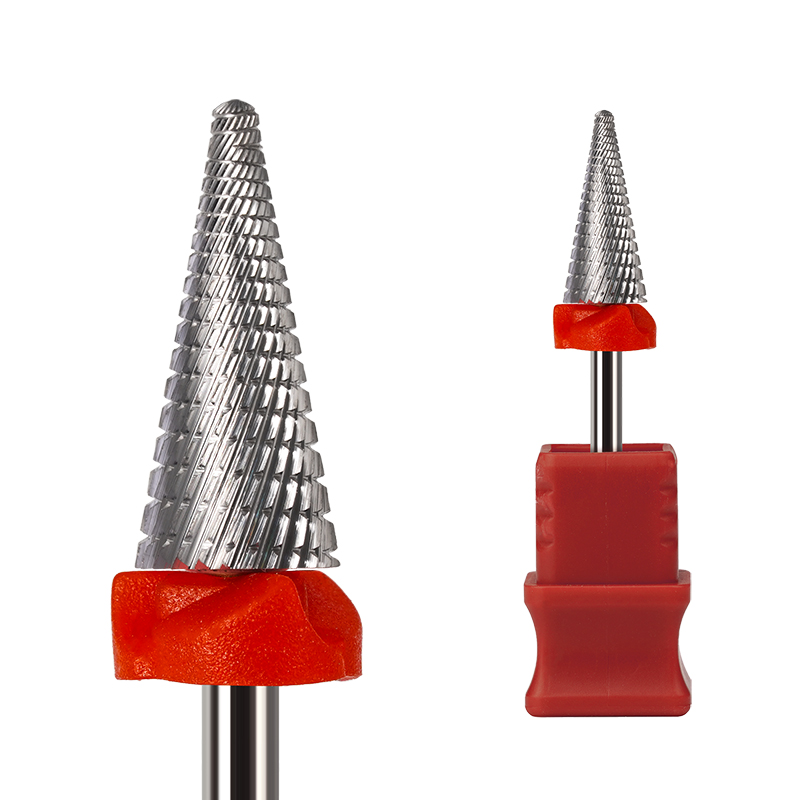
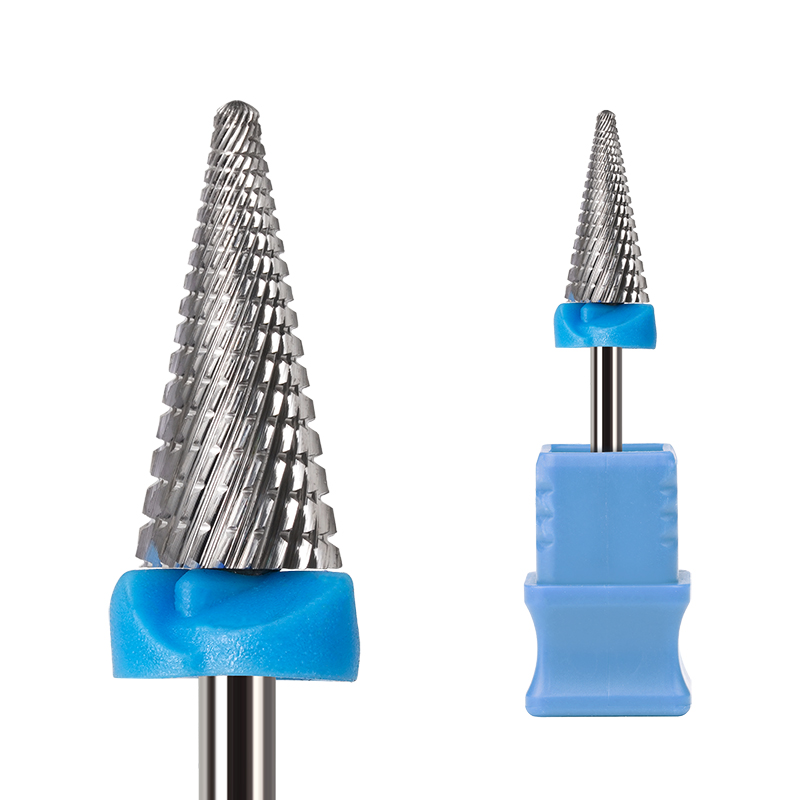
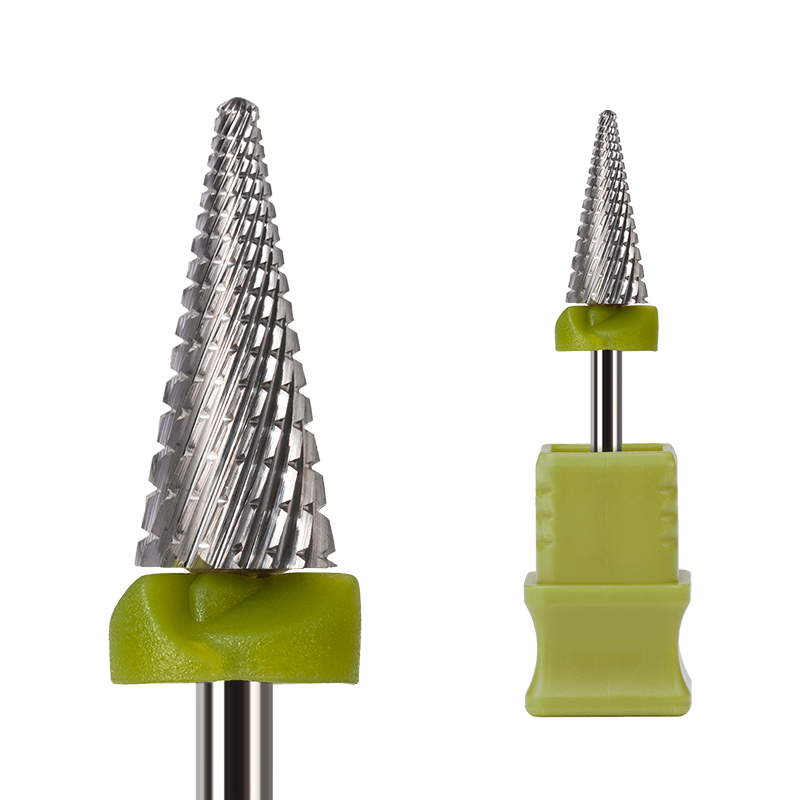
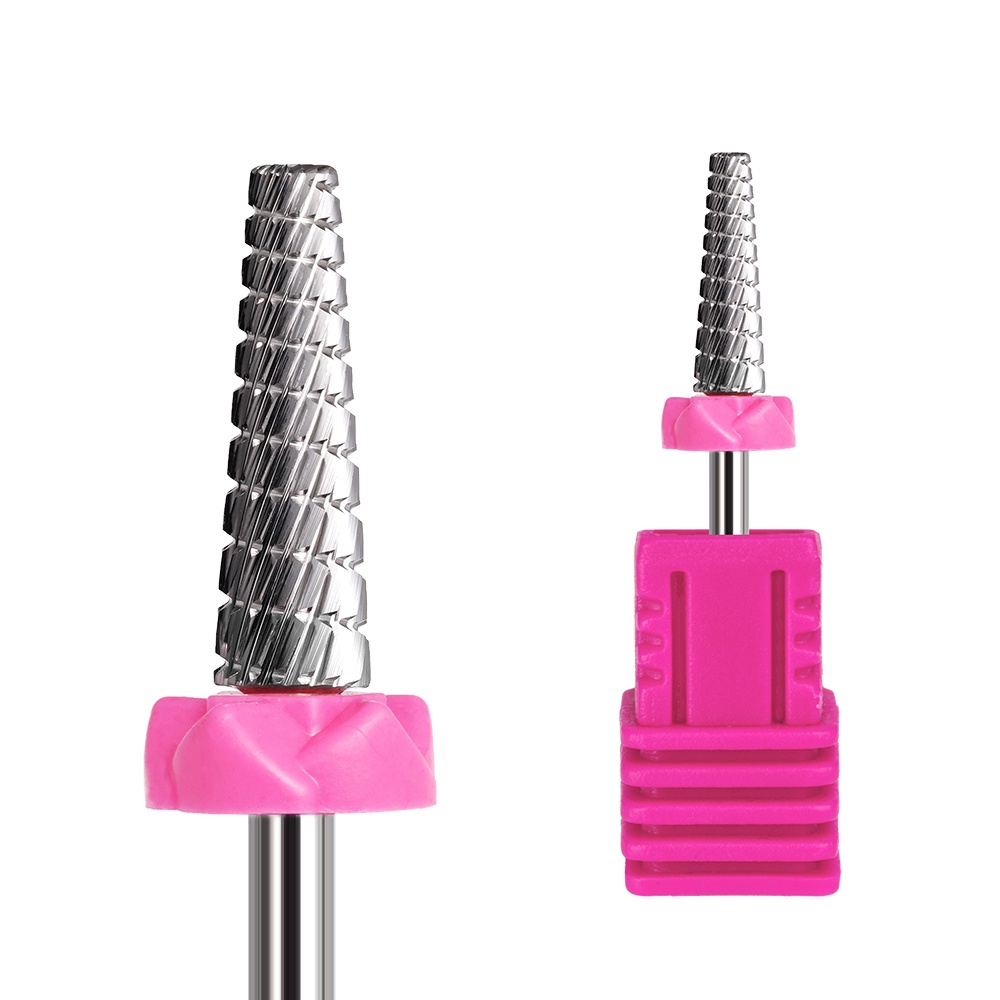
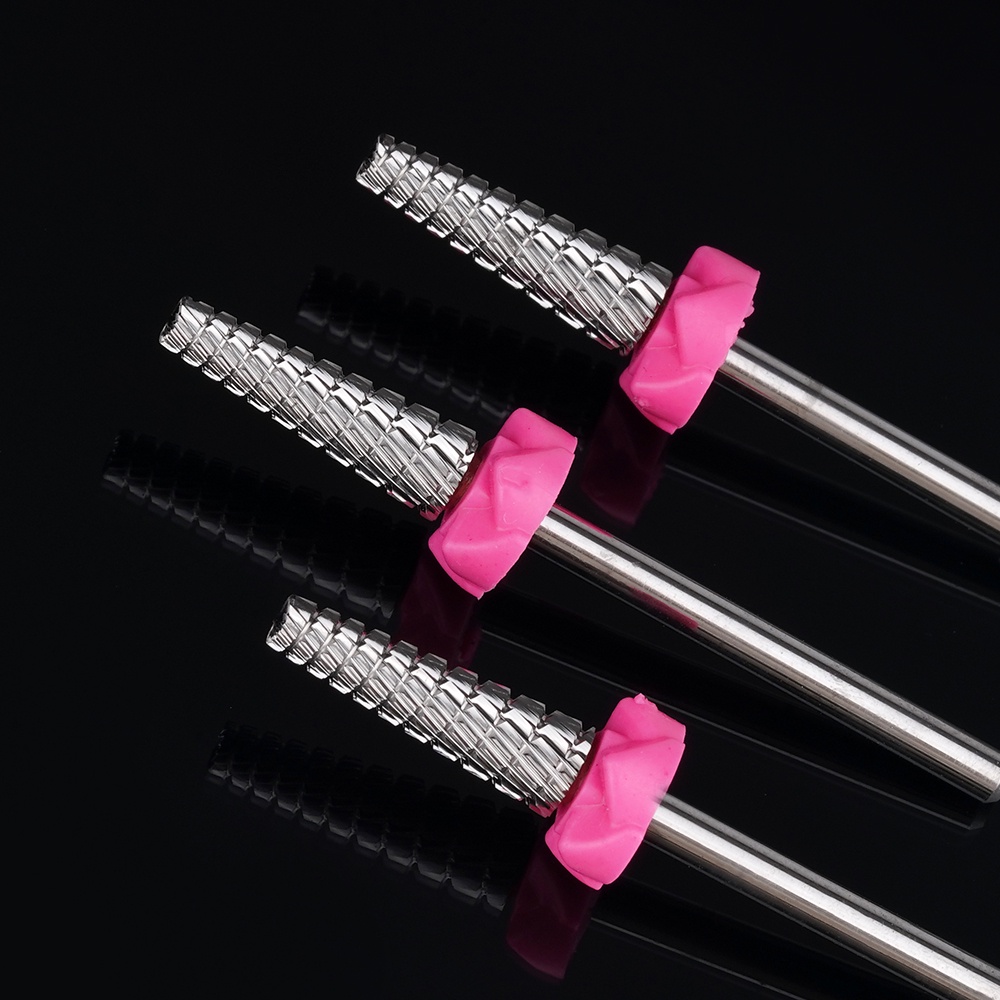
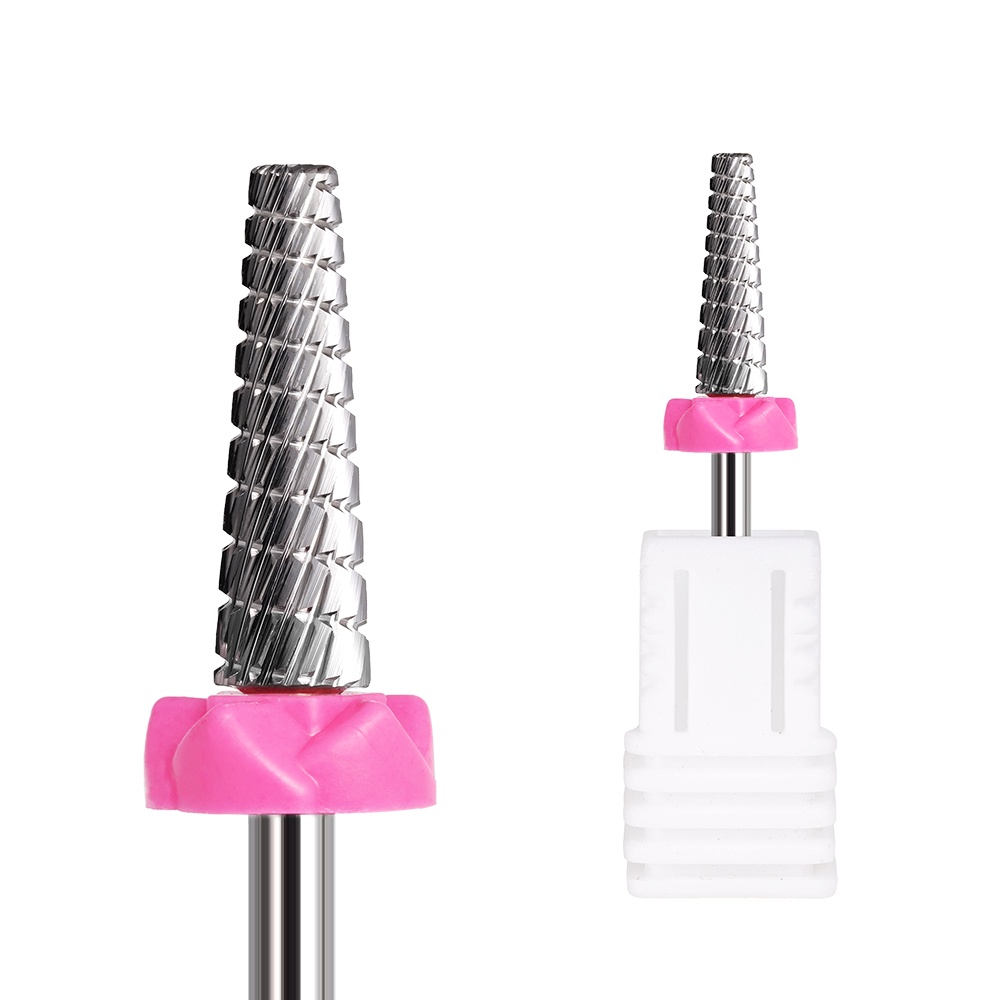
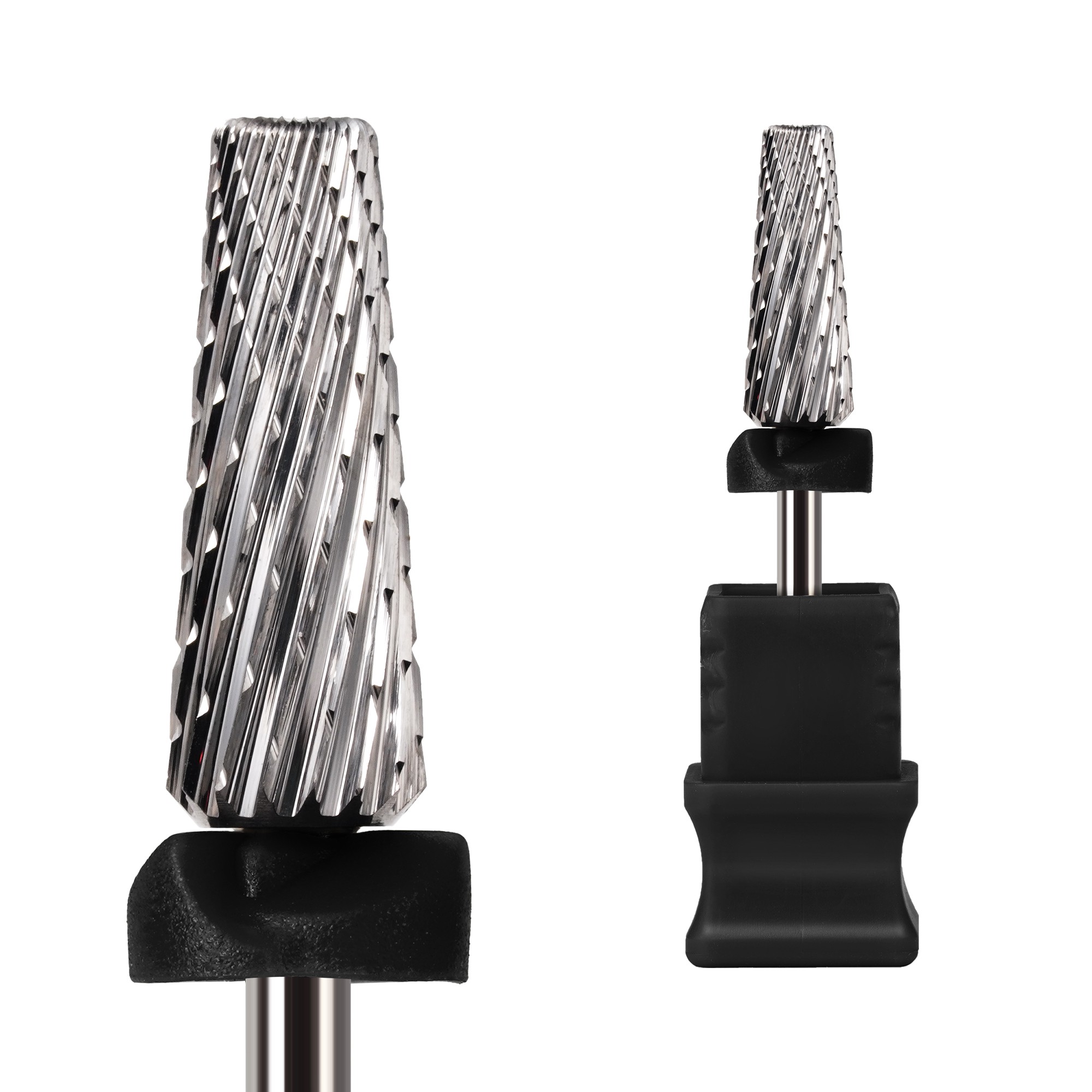
A tungsten carbide bit is relevant chiefly for product reduction. Its flutes cut through gel efficiently and tend to retain their cutting edges better than softer metal attachments. It is not automatically the right choice for every step. Coarse carbide is efficient on a thick hard-gel surface, but it is excessive for cuticle cleanup or final natural-nail preparation. A set such as Nail Drill Bit Factory carbide nail drill bits Tungsten Carbide Nail Drill Bit illustrates the useful distinction between coarse, medium, and fine options: the chosen grit needs to follow the layer being removed, not simply the desire to finish faster.
Shape changes control more than grit does
Grit is often emphasized on product listings, yet bit geometry can be the first factor that determines whether a task feels manageable. A wide barrel spreads contact over a broad area and is efficient on the center of an enhancement. It becomes awkward near sidewalls because its edge can catch or rub the skin before the working face reaches the material. A narrow bit has less contact area, making it slower on a full nail but more accurate in tight spaces.
Rounded or safety-top barrels offer a margin of protection when moving near the cuticle area. That does not make them harmless. The cutting surface below the rounded top still removes material, and a fast-moving barrel can produce heat before discomfort is noticed. Sharp pointed bits allow very precise work, but they require steadier control and a clear view of the area being filed. They are best reserved for a kit that already includes a forgiving general-purpose bit.
For pedicure use, the distinction is even stronger. A bit intended for gel is not necessarily a suitable callus tool. Gel bits are designed to cut coating material; rough skin is flexible, uneven, and often located on curved areas that are easy to overwork. A fine or medium pedicure attachment can smooth superficial roughness, while heavy callus removal requires restraint. Stop when the surface is even and comfortable rather than trying to make it completely smooth in one session.
A compact kit succeeds only with a compatible drill
Before choosing bits, confirm the shank size accepted by the handpiece and whether the drill runs smoothly at the lower end of its speed range. A bit set cannot compensate for a handpiece that wobbles, stalls, or changes speed under light contact. Runout, the visible side-to-side movement at the bit tip, makes even a fine bit feel rough and can create uneven grooves. Remove the bit, clean the chuck, reinsert it fully as directed by the drill manufacturer, and test again before assuming the attachment itself is defective.
Direction also matters. Most fluted carbide bits are cut for a particular rotation direction. A right-handed bit used in reverse may scrape poorly, snag, or require excess force. Reversible drills can be useful, but the bit design still needs to suit the selected direction. Sanding bands and many rounded abrasives are less direction-sensitive, while aggressively fluted barrels deserve closer attention.
Noise and vibration are also practical selection clues. Some vibration comes from high speed, but a new bit that shakes at low speed may be bent, improperly seated, or poorly balanced. Continuing to use it can make close work near the cuticle inaccurate. A stable bit should track cleanly, allowing the handpiece to glide rather than bounce.
Where six bits start to fall short
A basic set becomes restrictive when it tries to serve both frequent hard-gel removal and detailed natural-nail work without separate grits or shapes. A single medium barrel can perform both only with compromise: it may be too slow for dense overlays and too assertive for thin nails. Frequent acrylic reduction, long sculpted extensions, elaborate under-nail cleanup, and extensive foot care each create a reason to add specialized attachments later.
Replacement needs should also be expected. Abrasive bands are consumable and should not be treated as permanent tools. Carbide bits gradually lose cutting efficiency; pressing harder to compensate for a dull bit creates heat and reduces control. Diamond-coated detail bits can accumulate product and skin residue that makes them feel ineffective even when the abrasive surface is still intact. Cleaning may restore performance, whereas a visibly damaged, rusted, or bent bit should be discarded.
Six bits are therefore enough as a working foundation, not a promise that every nail task will need no additional tool. A hand file remains useful for finishing the free edge, and a buffer can soften minor surface scratches without concentrating rotary friction in one area.
Use sequence matters more than speed
Start with clean, dry hands or feet and examine the surface before switching on the drill. Remove loose decorative elements by hand where possible. On gel, use the broadest suitable bit only on the broad central area, moving in continuous passes from cuticle toward free edge or in another consistent pattern that avoids lingering. Reduce speed and change to a narrower or finer bit as the work approaches sidewalls and the cuticle margin.
Let the rotating bit do the cutting. Pressing is a common source of heat, grooves, and sudden skips. Keep the handpiece supported, use a shallow angle rather than the tip alone, and periodically pause to brush away dust. Dust hides layer changes and makes it easy to keep filing after the target material has already been removed.
After use, remove visible debris with a suitable cleaning brush, then clean and dry the bits according to their material and the product instructions. Storage in a dry case prevents edges from striking each other and reduces the chance of corrosion. Do not share uncleaned bits between people, especially where skin has been abraded.
A manicure pedicure kit with six drill bits covers home care well when it contains distinct working shapes, includes a fine option for finishing, and uses enough cutting ability for the coatings actually worn. Choose the set by task coverage and control at low speed, then expand only when a recurring task exposes a genuine gap.
News List
- Preventing Gouges and Uneven Filing With Small Barrel Nail Drill BitsSep 20, 2026
- How Diameter and Grit Affect Small Barrel Nail Drill Bit PerformanceSep 20, 2026
- Can Hytos Nail Drill Bits Be Used Safely on Natural Nails and Gel Polish?Sep 20, 2026
- How to Verify Fit Between Hytos Nail Drill Bits and an E-File HandpieceSep 20, 2026
- Safe Speed Settings for Umbrella Nail Drill Bits Around the Nail FoldSep 20, 2026
- Umbrella vs Flame Nail Drill Bits: Which Shape Offers Better Cuticle Control?Sep 20, 2026
Best-Selling Products
 Cross Cut Safety Stainless Steel Tungsten Carbide Nail Drill Bits Salon Foot Use XF-C Grit for Removing Nails
 First-rate Quality Tungsten Carbide Nail Drill Bits Best Coating Manicure Remove Gel Nails Accessories
 Professional Advanced Safety Cuticle Bits Two-Way Rotate 3/32'' Carbide Tungsten 5 in 1 Nail Drill Bits
 Wholesale 5 in 1 Electric Manicure Nail Drill Bits Various Coating Cone Cuticle Bit with Rotary Cross Cut for Nail Art
 New Slant Tooth Tungsten Steel Nail Drill Bits Dead Skin Removal 5-in-1 Universal Grinding Nail Polish Head Tool Nail Drill Bits
 4.0mm Small 5 in 1 Integrated Sharpe Tungsten Nail Drill Bit Straight Teeth Gel Polish Removal
 Flame Sharp XF F M C XC Silver Safety Professional Corn Tungsten Carbide Nail Bit for Drill Machine Accessories
 Factory Direct 5 in 1 Tungsten Carbide Nail Drill Bits 6.8MM Cross Cut Safety Manicure 5 in 1 Nail Drill Bits
Please give us a message