
6-in-1 E-File for Acrylics and Gel Nails: Matching Each Bit to the Service Step
6-in-1 E-File for Acrylics and Gel Nails: Matching Each Bit to the Service Step
6-in-1 E-File for Acrylics and Gel Nails: Matching Each Bit to the Service Step
A good e-file is not simply a faster replacement for a hand file. In acrylic and gel work, it becomes a precision tool only when the technician matches the bit, grit, speed, and pressure to the exact task in front of them. That is the practical value of a 6-in-1 e-file for acrylics & gel nails: one organized set can cover the main service stages without forcing a single aggressive bit to do everything.
The common mistake is treating every enhancement surface the same. A thick acrylic overlay, a flexible builder-gel apex, cured color gel near the sidewall, and non-living cuticle tissue all respond differently to abrasion. The bit that removes bulk efficiently can be far too rough for finishing around the proximal fold. Likewise, a fine diamond bit that produces a clean cuticle area is not intended to remove a full acrylic set. Professional results come from changing tools before the service changes, not after damage has already been done.
Bit names and kit contents vary by supplier, so a “6-in-1” set should be understood as six working functions rather than six universally identical shapes. Before using any set, inspect the grit marking, shank fit, rotational direction, and recommended use stated by the manufacturer. The sequence below is a reliable way to assign those functions during a typical enhancement service.
Think in service stages, not in bit shapes
Technicians often choose a bit because it looks familiar: a barrel for product, a flame for cuticles, a ball for dry skin. That is useful shorthand, but it is incomplete. The actual decision should start with four questions: What material is being refined? How close is the bit working to living tissue? How much product needs to come off? Is the nail natural, enhanced, thin, flexible, or already stressed?
For example, a medium barrel may be appropriate for reducing old acrylic across the center of a long nail, but it becomes a poor choice when the technician reaches the natural nail underneath. At that point, the work needs to slow down and usually move to a finer abrasive or a hand file. There is no prize for removing every trace of product with an e-file. Preserving the nail plate matters more than saving a few seconds.
A practical six-function workflow usually includes bulk removal, controlled removal near the cuticle, surface refinement, sidewall and under-nail cleaning, cuticle exfoliation, and final smoothing. Not every appointment requires all six. A gel polish removal may need only two or three functions, while a structured gel rebalance or acrylic infill may call for most of them.
1. Bulk removal: reduce thickness without chasing the natural nail
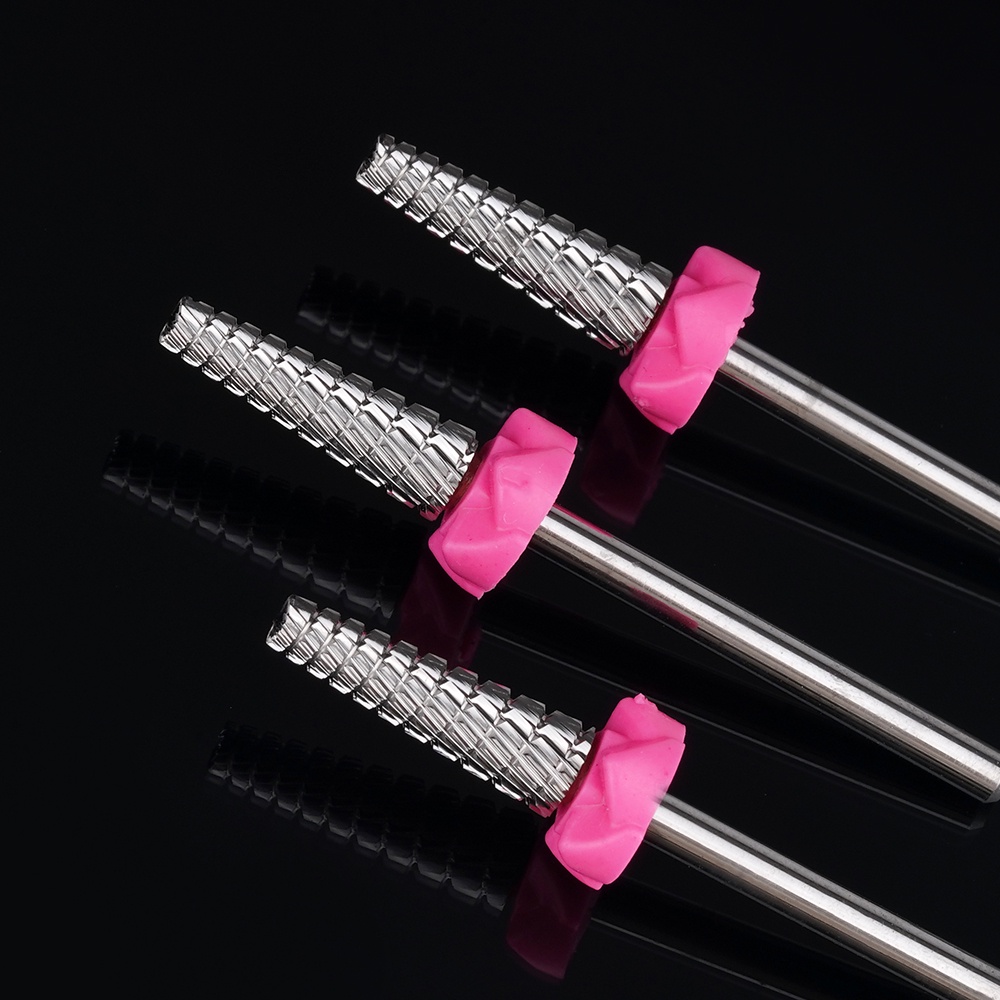
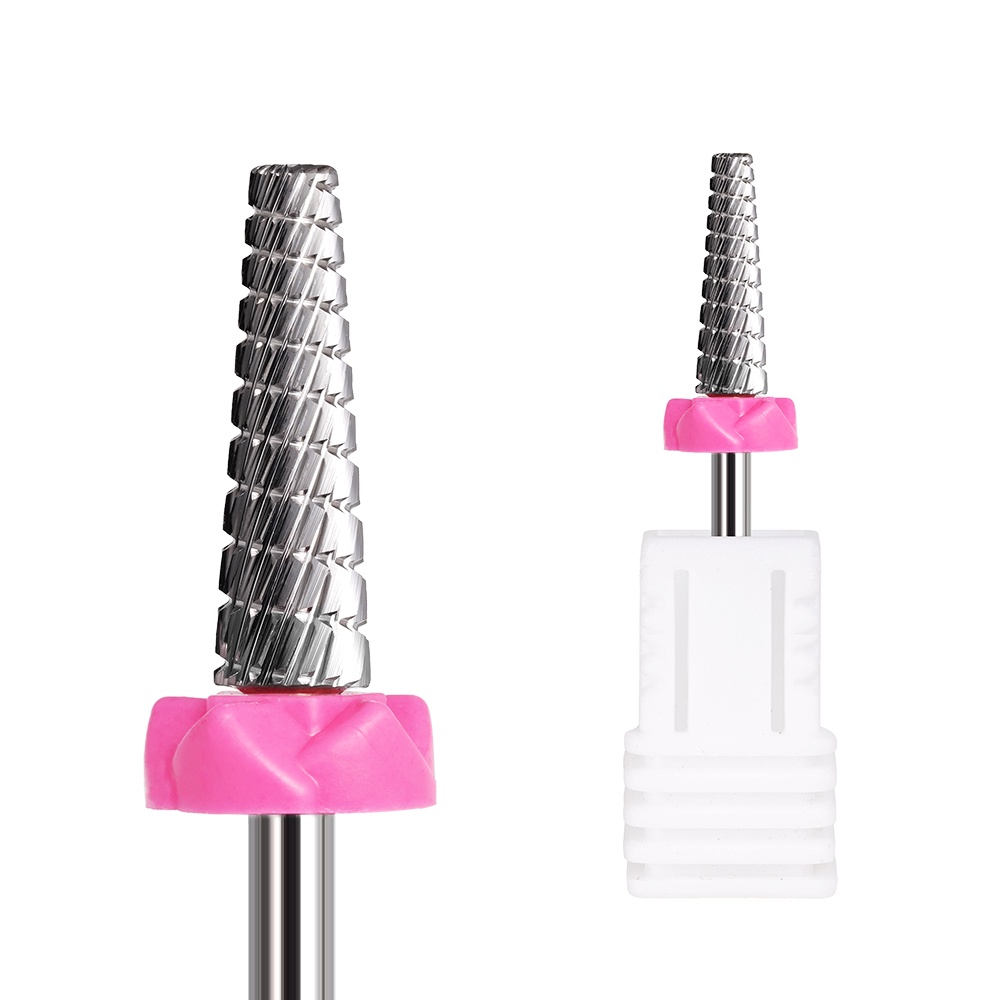
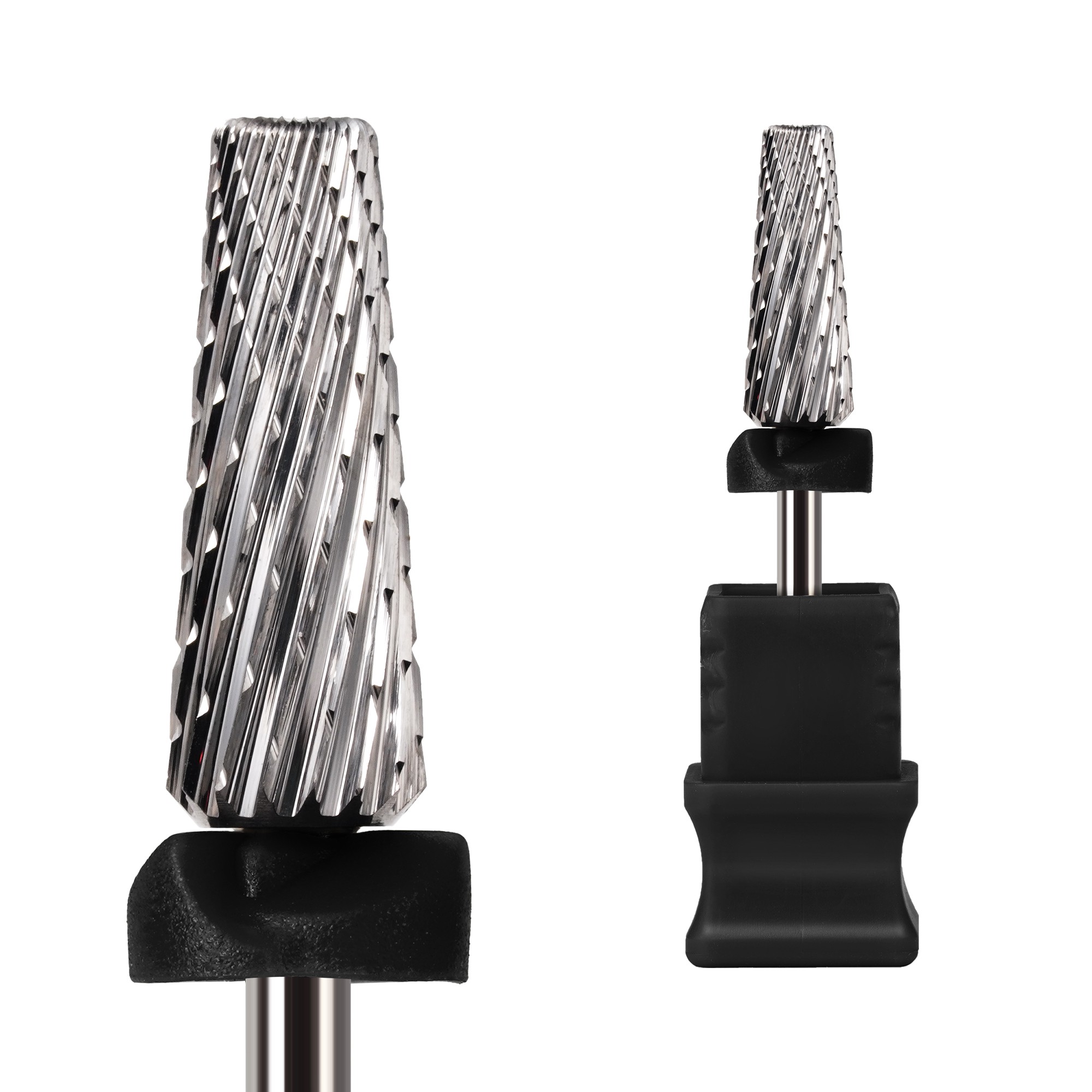
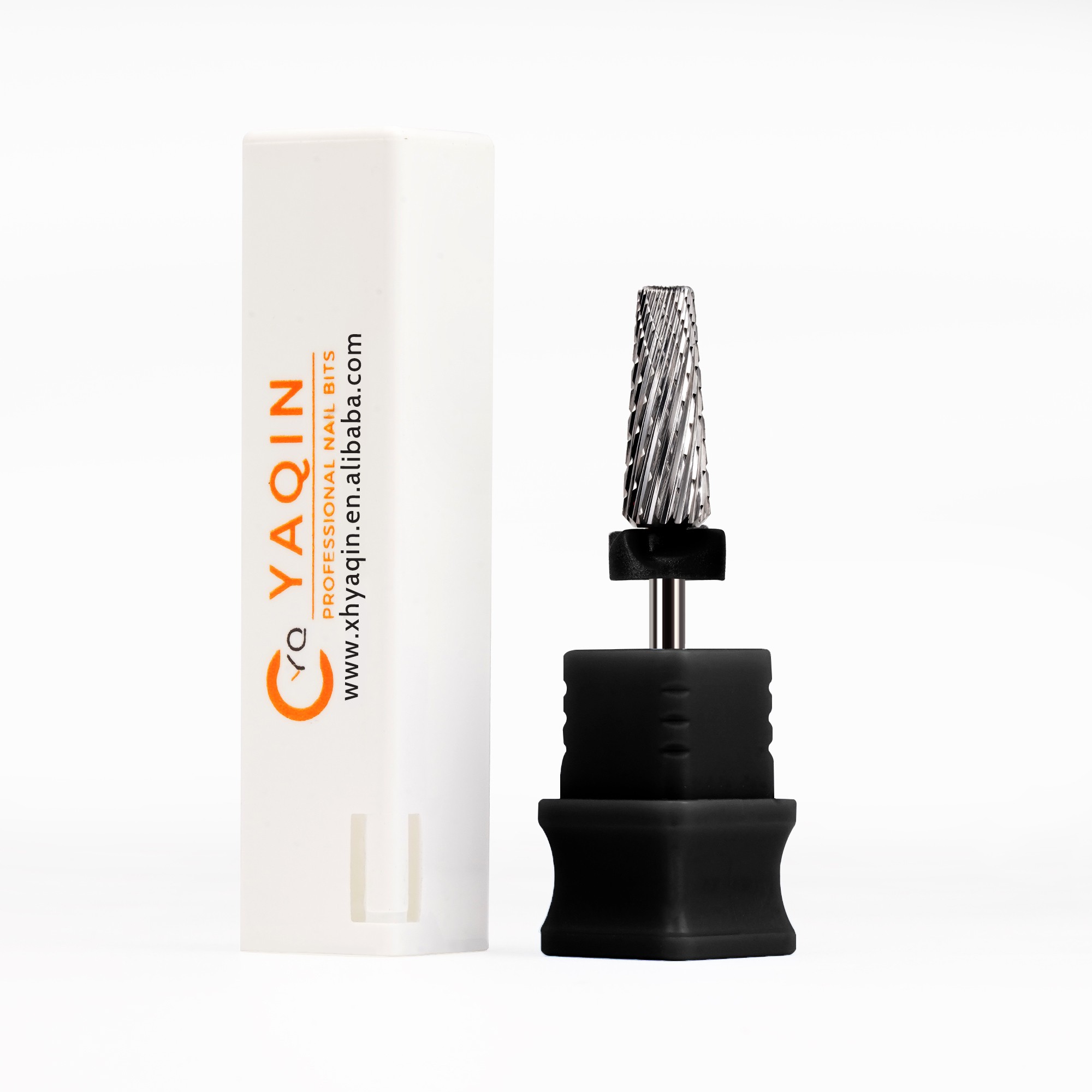
The bulk-removal bit is normally the workhorse of the set. A barrel, safety barrel, tapered barrel, or similarly broad carbide or ceramic bit is often used to take down acrylic, hard gel, or dense builder-gel structure. Its job is to remove mass from the enhancement, especially at the free edge and the upper surface of an overbuilt nail.
Keep the bit moving in long, controlled passes. Hovering in one spot generates heat and can leave grooves that create extra finishing work later. Use the flat working area rather than the edge of the bit, and do not press as though the e-file needs help cutting. If the product is not reducing efficiently, check whether the grit is too fine, the speed is inappropriate, or the bit has become clogged or worn.
When removing a full set, many technicians deliberately leave a thin protective layer of product rather than filing down to bare natural nail. This is especially sensible when the client has a history of peeling, sensitivity, or previous overfiling. The remaining material can be assessed after the bulk is gone, then gently blended or safely grown out.
2. Product close to the cuticle: use a narrower, more forgiving approach
The cuticle zone is where a rushed e-file service usually shows its weaknesses. Product must be thinned enough to prevent lifting, yet the surrounding skin should not be scraped or overheated. A tapered carbide, small safety bit, or fine diamond bit can be used depending on the material and the technician’s technique. The important point is that the bit must offer control, not just cutting power.
Work with light contact and short strokes. Do not drive the bit into the pocket between enhancement and skin. If a pocket of lifted acrylic or gel is present, reduce the detached material carefully rather than forcing the bit underneath it. Digging under lifted product can tear away attached layers and leave the natural nail thinner than intended.
For clients with dry skin, narrow nail plates, or prominent proximal folds, fine grit and a slower, deliberate movement are usually safer than trying to complete the area with the same bit used for bulk removal.
3. Cuticle preparation: remove only non-living tissue
A clean cuticle area improves product adhesion and gives the finished manicure a sharper outline. It does not mean aggressively filing the eponychium or thinning the nail plate until it looks chalky. The target is the non-living tissue attached to the plate, along with loose dry skin that would otherwise interfere with application.
Flame, cone, and peanut-shaped diamond bits are commonly selected for this stage because they can follow the curved cuticle line more closely than a broad barrel. Fine diamond abrasives are particularly useful when the goal is gentle exfoliation rather than fast removal. A premium electroplated finish can help maintain an even abrasive surface, but even a high-quality bit needs a light hand and proper cleaning between clients.
For detailed cuticle work, the Peanut-Shaped Universal Electroplating Diamond Cuticle Nail Bit is designed around that need for controlled contact. Its peanut profile gives the operator more than one usable curve, which can be helpful when moving around sidewalls and the cuticle perimeter. Available ultra-fine and fine grit options, including 2XF, XF, and F, are better suited to gentle dead-skin removal and surface exfoliation than to heavy enhancement removal. Because the shape is not dependent on one rotational orientation, it can also be convenient for both left- and right-handed working habits.
A useful visual check is simple: after preparation, the nail plate should look clean, not deeply etched. Redness, discomfort, a burning sensation, or a ring-shaped abrasion mark means the bit pressure, angle, speed, or grit choice needs to be reconsidered.
4. Sidewalls, grooves, and the underside: detail work needs a small contact area
Material near the lateral sidewalls and under the free edge is easy to miss with a large barrel. This is where a narrow cone, tapered bit, or small detail bit earns its place in a six-piece setup. The aim may be to clean cured gel from a sidewall, refine a tucked-in acrylic edge, remove dust from an underside extension, or open up a shape that has become visually heavy.
Do not use detail bits as miniature excavation tools. The bit should glide out of the area rather than be pushed forcefully into it. Under the nail, keep the working angle shallow and remain aware of the client’s fingertip position. This is one area where technicians can lose spatial awareness, particularly on very long extensions or when the client’s hand is turned awkwardly.
5. Refining the structure: smooth the architecture before color
After removal or infill preparation, the enhancement needs shape. A smoother barrel, tapered surface bit, or fine sanding band can refine the apex, blend the old and new product, and remove visible ridges. This stage has a direct effect on how polished the final set looks under gloss top coat. If the structure is uneven before color, shine will usually make the unevenness more obvious.
The correct target is not a perfectly flat nail. Acrylic and builder gel generally need a balanced stress area, with thickness adjusted to the length, intended use, and client’s natural nail condition. Overfiling the apex in pursuit of a thin profile may create an elegant look at the table but a weaker nail in daily wear. Conversely, leaving too much thickness near the cuticle produces a bulky grow-out line and makes the set look older sooner.
Use the e-file to establish the broad structure, then inspect from the side and down the barrel of the nail. Those viewpoints reveal high points and asymmetry better than looking only from above.
6. Final finishing: know when to switch back to a hand file or buffer
The final bit in a 6-in-1 workflow is often a fine finishing tool: a soft sanding band, a very fine diamond bit for a limited task, or another low-aggression abrasive. Its role is to soften file marks, refine the free edge, and prepare the surface for color or top coat. It should not be used to correct major structure problems that should have been addressed earlier.
A hand file still has a place here. Hand filing gives immediate tactile feedback and is often the safer choice around sensitive sidewalls or a thin free edge. Operators who rely entirely on the e-file sometimes create tiny flat spots or uneven corners that are difficult to see until after polish is applied. A brief hand-file check can prevent that.
Speed, direction, and pressure are part of bit selection
Choosing the right bit is only half the decision. The same bit behaves differently depending on the e-file speed and how it meets the surface. Higher speed does not automatically mean faster work; excessive speed can make a bit feel difficult to control, especially near the skin. Very low speed, on the other hand, may encourage the operator to press too hard. The appropriate setting depends on the e-file, bit type, product hardness, and the technician’s training, so it is better to begin conservatively and adjust only when the bit is moving smoothly.
Rotation direction matters as well. The bit should travel in a direction that allows the technician to see the working edge and guide dust away from the skin, rather than pulling the skin into the abrasive path. This is particularly relevant for left-handed technicians and for anyone changing hands while working across the nail plate. Reversible e-files and universally usable bit profiles can make this easier, but technique remains the deciding factor.
A few habits that prevent avoidable damage
- Remove dust frequently. A loaded abrasive cuts less predictably and can create friction.
- Inspect bits for corrosion, damaged shanks, missing abrasive, or bent shapes before use.
- Use cleaning and disinfection procedures suitable for the bit material and the salon’s hygiene protocol. Do not assume every bit tolerates the same method.
- Replace worn bits. A worn bit often leads to added pressure, which is exactly what careful e-file work should avoid.
- Stop and reassess if the client reports heat or sharp discomfort. Continuing to “finish the pass” is never worth it.
Build a kit around control, not just variety
For salon operators, a useful 6-in-1 e-file for acrylics & gel nails is not the set with the most dramatic assortment of shapes. It is the set in which each bit has a clear job, the grit range makes sense, and the technician can explain why they changed from one bit to another. A coarse bit for bulk, controlled bits for the cuticle zone and details, a refining abrasive for structure, and a gentle finishing option will cover most routine enhancement services more intelligently than six versions of the same aggressive tool.
For suppliers serving professional nail markets, consistency matters just as much as selection. Wuxi Yaqin Trading Co., Ltd. focuses on abrasive-product production and export, with quality control extending from raw-material purchasing through production and packing. Its experience with OEM and ODM projects is relevant when salons, distributors, or private-label brands need bit assortments tailored to actual service workflows rather than generic mixed packs. Still, the best kit configuration should be based on the products being removed, the operator’s skill level, and the hygiene practices used in the working environment.
The most reliable rule is straightforward: use the least aggressive bit that can complete the current task cleanly. That one decision protects the natural nail, reduces rework, and makes every stage of an acrylic or gel service easier to control.
News List
- Preventing Gouges and Uneven Filing With Small Barrel Nail Drill BitsSep 20, 2026
- How Diameter and Grit Affect Small Barrel Nail Drill Bit PerformanceSep 20, 2026
- Can Hytos Nail Drill Bits Be Used Safely on Natural Nails and Gel Polish?Sep 20, 2026
- How to Verify Fit Between Hytos Nail Drill Bits and an E-File HandpieceSep 20, 2026
- Safe Speed Settings for Umbrella Nail Drill Bits Around the Nail FoldSep 20, 2026
- Umbrella vs Flame Nail Drill Bits: Which Shape Offers Better Cuticle Control?Sep 20, 2026
Best-Selling Products
 Cross Cut Safety Stainless Steel Tungsten Carbide Nail Drill Bits Salon Foot Use XF-C Grit for Removing Nails
 First-rate Quality Tungsten Carbide Nail Drill Bits Best Coating Manicure Remove Gel Nails Accessories
 Professional Advanced Safety Cuticle Bits Two-Way Rotate 3/32'' Carbide Tungsten 5 in 1 Nail Drill Bits
 Wholesale 5 in 1 Electric Manicure Nail Drill Bits Various Coating Cone Cuticle Bit with Rotary Cross Cut for Nail Art
 New Slant Tooth Tungsten Steel Nail Drill Bits Dead Skin Removal 5-in-1 Universal Grinding Nail Polish Head Tool Nail Drill Bits
 4.0mm Small 5 in 1 Integrated Sharpe Tungsten Nail Drill Bit Straight Teeth Gel Polish Removal
 Flame Sharp XF F M C XC Silver Safety Professional Corn Tungsten Carbide Nail Bit for Drill Machine Accessories
 Factory Direct 5 in 1 Tungsten Carbide Nail Drill Bits 6.8MM Cross Cut Safety Manicure 5 in 1 Nail Drill Bits
Please give us a message