
How to verify product consistency from a nail drill bit supplier in France
How to verify product consistency from a nail drill bit supplier in France
In the nail care supply chain, inconsistency rarely shows up in the first carton. It appears later—when one batch cuts smoothly and the next feels rougher, when electroplating wears faster than expected, or when a safety review finds labeling that does not match the delivered grit. That is why choosing a nail drill bit supplier France should never be treated as a simple sourcing task. For QC teams and safety managers, the real question is not whether a supplier can ship product once, but whether they can repeat the same product characteristics, documentation discipline, and packaging accuracy batch after batch.
The French market adds another layer of responsibility. Importers, distributors, and private-label buyers are expected to demonstrate traceability, product conformity, and clear internal controls. If a supplier cannot explain how raw materials are checked, how process variation is controlled, or how nonconforming items are isolated, then low unit cost quickly becomes an expensive risk.
When you evaluate supplier stability, product consistency should be verified through evidence, not assurances. A polished sample is useful, but it is only the beginning.
What “product consistency” really means for nail drill bits
Consistency in abrasive nail tools is broader than appearance. A batch may look identical while performing differently in practice. For nail drill bits, especially abrasive or diamond-coated types, consistency usually involves several measurable and observable points:
- Uniform grit and cutting feel across production lots
- Stable plating or abrasive adhesion
- Repeatable dimensions, shape, and shank fit
- Controlled edge finishing without burrs or sharp defects
- Reliable packaging, labeling, and lot identification
- Traceable raw material and process records
For safety management personnel, these points matter because variability can lead to overheating, skin irritation, unstable use on electric handpieces, or complaints related to unexpected wear. For QC personnel, the issue is simpler: if the supplier cannot control variation, incoming inspection will become a constant firefighting exercise.
Start upstream: ask how raw materials are verified
A consistent finished bit usually starts with disciplined incoming control. Before discussing certificates, ask a prospective supplier in practical terms how they manage raw material purchasing and acceptance. This is especially relevant when dealing with abrasive products, where subtle variation in base materials or coating inputs can affect durability and performance.
Useful verification questions include:
- Are incoming materials checked against defined specifications?
- Is there a record linking material batches to finished product lots?
- How are rejected materials identified and segregated?
- Does the supplier rely on approved vendors or buy opportunistically?
Wuxi Yaqin Trading Co., Ltd., for example, positions itself as a trading factory focused on high-quality abrasive products, with a QC system that covers raw material purchasing, production process, and product packing. For a buyer in France, this kind of statement is not the conclusion—it is the starting point for document review. Ask to see how that system works in practice, not just how it is described in a brochure.
Review the production process, not just the finished sample
One common mistake in supplier approval is placing too much trust in pre-shipment samples. A sample can be carefully selected. A process, however, is much harder to fake over time. If you want to verify a nail drill bit supplier France option for long-term consistency, focus on process control points.
For electroplated or abrasive bits, that usually means understanding:
- How the bit shape is formed and checked
- How electroplating parameters are controlled
- How grit grade is defined and separated
- Whether in-process inspection exists between key steps
- How rework is handled and documented
Ask for process flowcharts, in-process inspection records, and examples of batch release criteria. A supplier with mature controls should be able to explain where variation tends to occur and what actions are taken when readings move outside acceptable range.
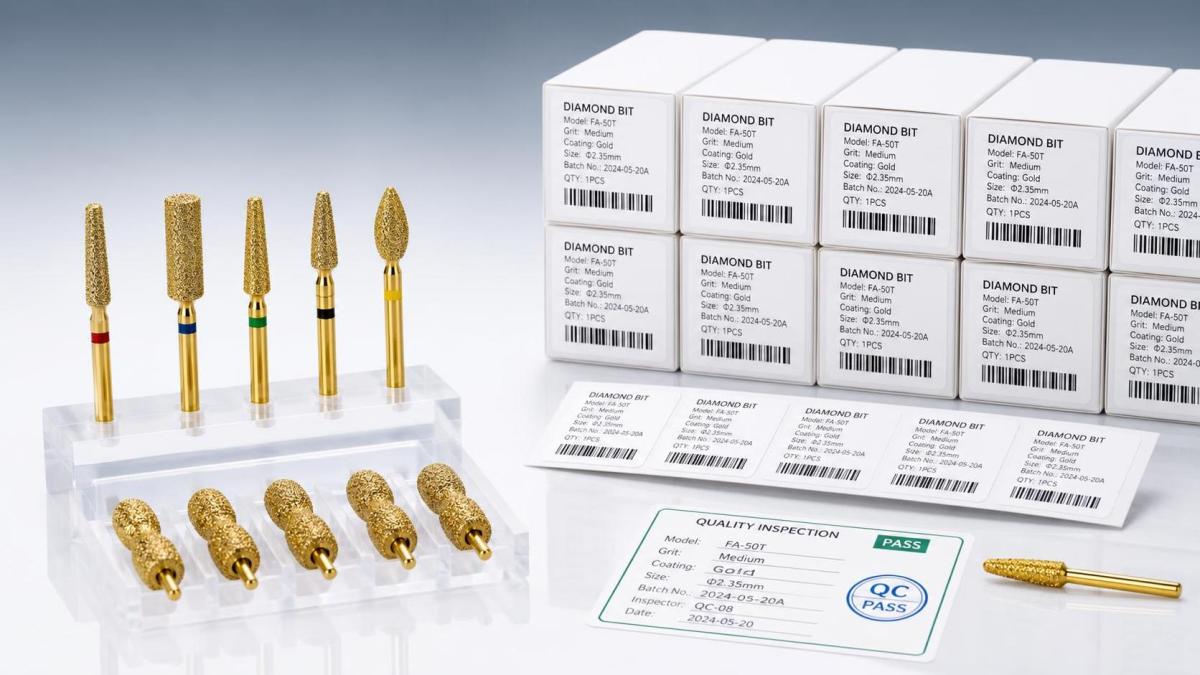
This is especially important for products such as the Peanut-Shaped Universal Electroplating Diamond Cuticle Nail Bit. A peanut-shaped bit intended for dead skin removal, gentle exfoliation, and callus smoothing must do more than look refined in photos. The electroplated finish needs to remain even, the shape must support controlled contact, and the grit classification—such as 2XF Ultra Fine, F Fine, or XF Extra Fine—must stay consistent enough that technicians do not need to relearn pressure and handling from batch to batch.
Certificates matter, but only if they connect to the actual product and system
In standard- and compliance-driven purchasing, certifications often receive too much symbolic value. An ISO certificate can indicate that a management system exists, but it does not prove that every drill bit is identical. Still, it remains relevant because it suggests whether the supplier works within documented procedures and internal review cycles.
If a supplier states that it has passed ISO9001:2000 quality management system certification, the next step is to clarify three things:
- Is the certification current and applicable to the product category being purchased?
- Does the scope include manufacturing or only trading functions?
- Can the supplier connect the certified system to actual inspection, corrective action, and traceability records?
QC managers should also look beyond the certificate itself. Ask how complaints are logged, how root cause investigations are conducted, and whether corrective actions feed back into process updates. Safety managers may want to confirm how packaging information, usage warnings, and product identification are controlled to reduce misuse risk once the product enters distribution.
Use a consistency checklist during sample approval
Technical approval becomes much stronger when the sample stage is formalized. Instead of evaluating only visual appearance, create a sample checklist that can later be reused during incoming inspection. This helps translate supplier promises into measurable acceptance standards.
Your checklist may include:
- Shape accuracy and symmetry
- Shank diameter fit and straightness
- Surface finish uniformity
- Grit feel and tactile consistency
- Coating adhesion observation after controlled use
- Cleanliness and absence of contamination
- Retail or bulk packaging correctness
- Label consistency with PO and approved specification
If your business involves private labeling, include artwork version control in the same approval file. Product consistency is not only about the bit itself. Wrong labels, mixed grit markings, or outdated pack inserts can create compliance and recall headaches even when the physical tool performs correctly.
Traceability is the difference between a problem and a manageable problem
No supplier is immune to deviation. What separates a reliable partner from a risky one is whether the deviation can be traced, contained, and corrected quickly. That is why lot coding should never be treated as a minor packaging detail.
Ask the supplier how a single shipment can be traced back to:
- Raw material purchase records
- Production date or line
- Inspection records
- Packing records
- Operator or supervisor release approval
A strong traceability system reduces exposure if a complaint arises in France after distribution. Instead of reviewing months of shipments blindly, you can isolate the affected lot, determine whether the issue is process-based or isolated, and take proportionate action.
Check packaging control more seriously than most buyers do
Packaging errors are often dismissed as administrative issues. In reality, they are one of the clearest signs of weak process discipline. A supplier that mixes labels, packs incorrect quantities, or fails to separate grit grades may have similar weaknesses in production segregation.
For nail drill bits, packaging verification should include:
- Correct product code and grit identification
- Batch or lot number presence
- Quantity accuracy per pack and carton
- Protection against moisture, contamination, and transit damage
- Outer carton consistency with inner labels
Wuxi Yaqin emphasizes that its QC system extends to product packing, and that is an important claim for buyers serving regulated or quality-sensitive channels. A stable packaging process supports warehouse accuracy, complaint handling, and safe product presentation all the way to the end customer.
Do not ignore user-side performance feedback
Consistency cannot be judged only inside the factory. If possible, include controlled field evaluation by trained technicians or internal testers. The goal is not marketing preference; it is performance stability. A bit may pass basic visual inspection but still feel inconsistent in real use due to slight grit or plating variation.
For a delicate shape such as a peanut-style cuticle bit, user feedback can reveal whether the tool feels equally balanced for left-handed and right-handed operation, whether the contact area behaves predictably on skin, and whether the fine abrasive action remains gentle rather than unexpectedly aggressive. These details matter because even a technically small deviation can become a safety or customer satisfaction issue in salons and professional use environments.
Questions that reveal whether a supplier is ready for long-term cooperation
When qualifying a nail drill bit supplier France buyers can rely on, your most useful questions are often the least glamorous ones. Ask what happens when something goes wrong.
- How is a nonconforming lot quarantined?
- Who authorizes release after corrective action?
- How are specification changes communicated to customers?
- Can retained samples be provided by batch?
- How long are QC and production records kept?
- What is the process for OEM/ODM change approval?
These questions are particularly relevant when working with a supplier offering one-stop service from production to delivery and supporting OEM/ODM projects. Customization increases the chance of version confusion unless change control is handled carefully. A supplier with experience across markets such as the USA, Canada, Germany, the UK, Italy, and Poland may already understand cross-border quality expectations, but you should still validate how those expectations are translated into your own product file and quality agreement.
A practical approval approach for French importers and distributors
If you want a working model rather than a theory, keep the approval process layered. Start with document review. Move to sample evaluation. Then perform a pilot order with tightened incoming inspection. Only after the pilot confirms repeatability should you scale the relationship.
This phased method gives QC and safety teams time to compare documentation, actual product, and packaging performance under real conditions. It also creates an internal record showing due diligence—a valuable point if questions later arise from auditors, channel partners, or your own management team.
In the end, verifying consistency is less about catching a supplier in a mistake and more about understanding whether their system can produce the same result tomorrow that it produced today. In abrasive nail products, that repeatability is what protects users, supports compliance, and keeps complaints from becoming routine. A supplier worth keeping will not be uncomfortable with that level of scrutiny. They will be prepared for it.
News List
- How to verify product consistency from a nail drill bit supplier in FranceAug 25, 2026
- Do lead times vary much between nail drill bit suppliers in SpainAug 25, 2026
- What to check before choosing a nail drill bit supplier in RussiaAug 25, 2026
- Are Tungsten Carbide Bits Suitable for Acrylic Nails?Aug 24, 2026
- Why Does My Electric Nail File Overheat With Certain Bits?Aug 24, 2026
- What Is the Difference Between XF and C Grit on Nail Bits?Aug 24, 2026
Best-Selling Products
 Cross Cut Safety Stainless Steel Tungsten Carbide Nail Drill Bits Salon Foot Use XF-C Grit for Removing Nails
 First-rate Quality Tungsten Carbide Nail Drill Bits Best Coating Manicure Remove Gel Nails Accessories
 Professional Advanced Safety Cuticle Bits Two-Way Rotate 3/32'' Carbide Tungsten 5 in 1 Nail Drill Bits
 Wholesale 5 in 1 Electric Manicure Nail Drill Bits Various Coating Cone Cuticle Bit with Rotary Cross Cut for Nail Art
 New Slant Tooth Tungsten Steel Nail Drill Bits Dead Skin Removal 5-in-1 Universal Grinding Nail Polish Head Tool Nail Drill Bits
 4.0mm Small 5 in 1 Integrated Sharpe Tungsten Nail Drill Bit Straight Teeth Gel Polish Removal
 Flame Sharp XF F M C XC Silver Safety Professional Corn Tungsten Carbide Nail Bit for Drill Machine Accessories
 Factory Direct 5 in 1 Tungsten Carbide Nail Drill Bits 6.8MM Cross Cut Safety Manicure 5 in 1 Nail Drill Bits
Please give us a message