
China Nail Drill Bit Options Compared: Ceramic, Carbide, and Diamond Uses
China Nail Drill Bit Options Compared: Ceramic, Carbide, and Diamond Uses
Choosing among ceramic, carbide, and diamond bits is rarely about which material is “best” in general. In real salon work, the better question is which bit keeps removal controlled, finish quality stable, and client discomfort low across the services you actually perform. For operators comparing a China Nail Drill Bit range, material choice affects heat buildup, dust behavior, cut speed, service rhythm, and how forgiving the tool is in daily hands-on use.
That is why the comparison matters. A bit that performs well on bulk gel removal may be inefficient for cuticle refinement. A bit that feels safe on natural nails may slow down back-to-back appointments if used for product debulking. When buyers or technicians treat all drill bits as interchangeable, they usually pay for it later through inconsistent finish, faster wear, rework, or avoidable client sensitivity.
What most users are actually trying to decide
Searchers looking into ceramic, carbide, and diamond options are usually not asking for a textbook definition. They are trying to answer a practical set of decisions:
- Which bit should handle product removal fastest without sacrificing control?
- Which material is more suitable for natural nail prep or cuticle-zone work?
- Which option is more tolerant of long daily use in a busy salon setting?
- How much does grit, shape, and operator technique matter compared with material alone?
- When does a lower-cost bit become expensive because of poor lifespan or unstable finish?
Those are the right questions, because the material itself is only part of the selection logic. Shape, flute design, grit, machine speed, sanitation method, and user skill all influence actual performance.
Ceramic bits: cooler cutting, lighter feel, but not for every workload
Ceramic bits are often chosen for e-file users who want smoother heat behavior and a lighter hand feel during removal. In many working environments, ceramic cuts product with less perceived friction than lower-grade metal bits, and technicians often like the way it handles gel polish, builder gel, and some acrylic overlays. For operators doing frequent removal work, especially where client comfort is a selling point, ceramic can be a practical option.
Its real advantage is not simply that it is “gentle.” That description is too vague. A ceramic bit can still create heat or discomfort if speed, pressure, and angle are wrong. What many users actually experience is that ceramic tends to offer a more controlled, less aggressive feel during top-layer removal, especially when the bit quality is consistent and the machine runs smoothly.
But ceramic also has limits. It is not always the first choice for every heavy-duty task, and it can be less forgiving if dropped. In busy workstations, accidental impact matters. A bit that performs well in use but chips in handling may not be the most economical choice over time. So ceramic makes the most sense when the service mix is weighted toward coating removal, controlled debulking, and operators who value lower perceived heat and lighter handling.
Carbide bits: the workhorse for speed and volume
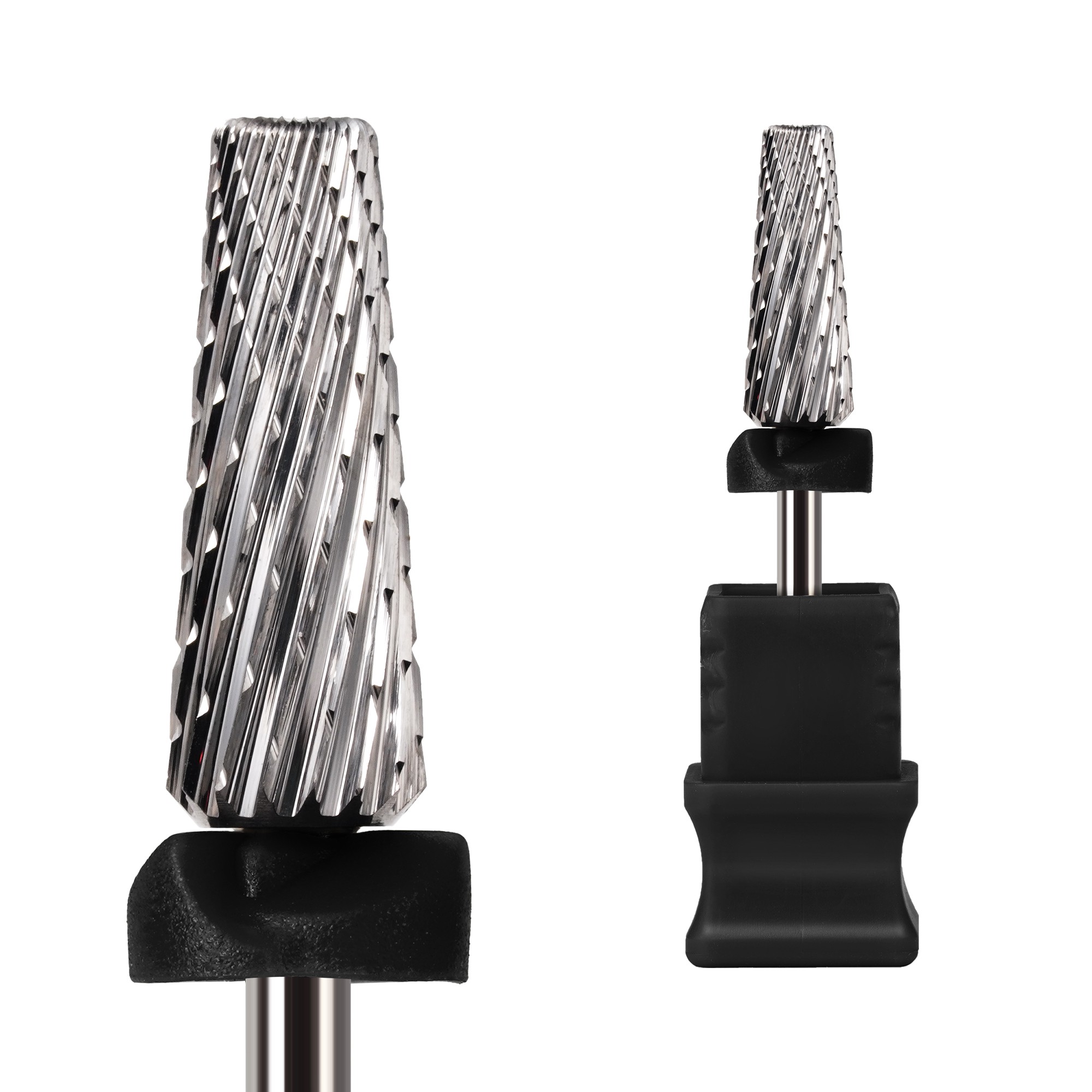
Carbide, especially tungsten carbide, is usually the material people reach for when efficiency matters most. In practical terms, carbide bits are widely used for acrylic removal, hard gel reduction, shaping enhancement product, and high-frequency salon workflows where speed is directly tied to labor capacity. If ceramic often wins on feel, carbide often wins on throughput.
This is also where a lot of misunderstandings appear. Some buyers assume carbide is automatically harsh. That is not quite right. A carbide bit’s behavior depends heavily on flute pattern, grit, shape, and hand control. A fine or medium carbide in the right shape can be precise and predictable, while a coarse one in the wrong hands can remove too aggressively. The material gives the bit durability and cutting power; it does not decide the final result by itself.
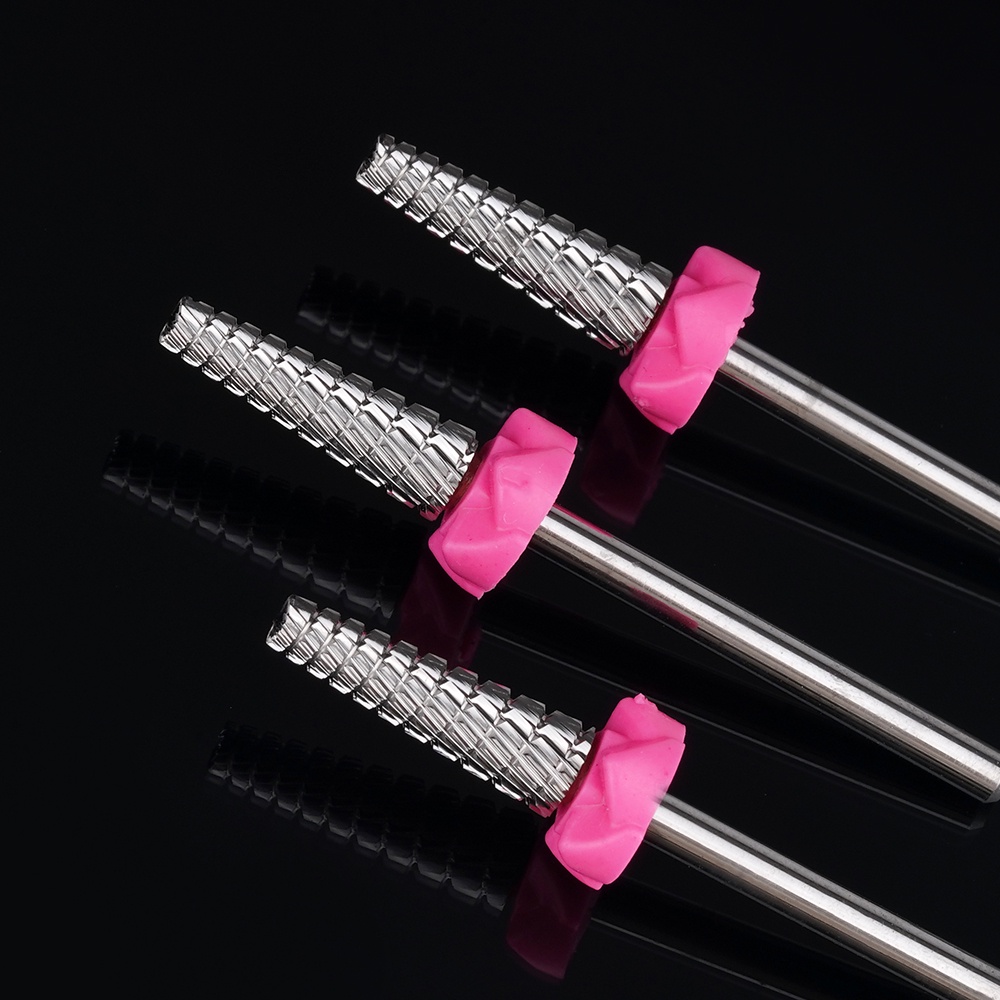
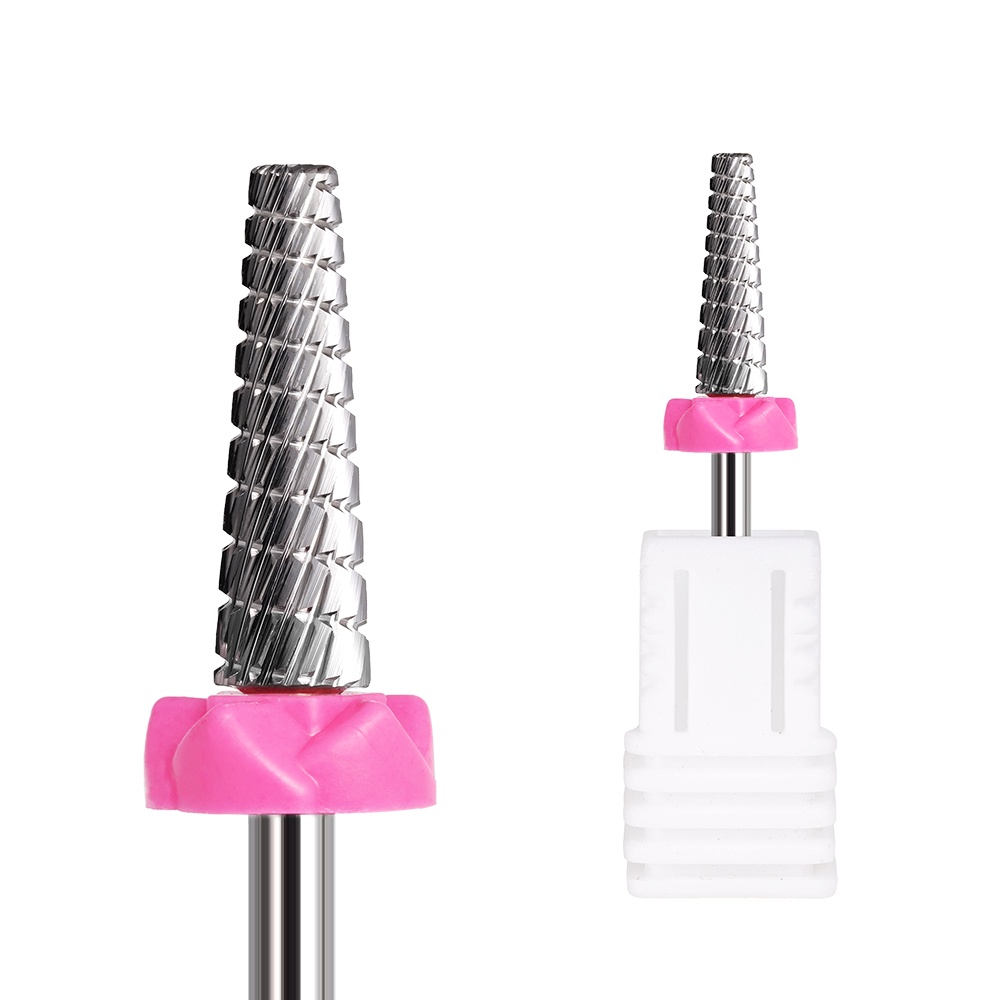
For example, flame-shaped carbide bits are often selected for more detailed work around sidewalls, the front edge, or localized removal tasks where access matters as much as cutting ability. In that context, a product such as F Grid Carbide Tungsten Nail Drill Bit Flame Shape fits the kind of use case where a technician needs precise hard-skin removal, cleanup after opening small pockets, and controlled prep or finishing on both manicure and pedicure services. The relevant point is not the item alone, but the selection logic behind it: when shape, durability, and compatibility with standard drill handles matter, carbide often becomes the practical choice.
Its main tradeoff is that carbide demands judgment. On natural nails or sensitive areas, poor technique shows immediately. For experienced operators, that is manageable. For less experienced users, it raises the training requirement. In other words, carbide is usually the productivity bit, but not necessarily the easiest bit to standardize across mixed skill levels.
Diamond bits: detail-focused, not bulk-removal tools
Diamond bits serve a different role and are often misunderstood by buyers who compare them too directly with ceramic or carbide. They are typically used for surface refining, cuticle work, cleaning around the nail fold, preparing small areas, and fine finishing rather than heavy product removal. If ceramic and carbide are often discussed in terms of removal speed, diamond bits should be discussed in terms of precision and surface management.
For natural nail prep and cuticle-zone detailing, diamond bits are common because they abrade rather than cut in the same way fluted carbide does. That makes them useful for controlled refinement, especially when operators need to remove dead skin carefully or clean tight areas without jumping to an overly aggressive tool. In salon workflows, they often function as supporting tools rather than the main removal bit.
The risk is using a diamond bit outside its role. It is inefficient for bulk product removal, and trying to force it into that task wastes time while increasing friction and user fatigue. If a technician expects one bit to do everything, diamond usually disappoints. If it is assigned to detail work, it often proves essential.
The material comparison that matters in real work
This comparison also shows why many professional users do not settle on one material only. A functional set usually combines them: carbide or ceramic for removal, diamond for detailing, and shape-specific options for sidewall or edge access.
Why shape and grit often matter as much as material
In purchasing discussions, people often focus first on ceramic versus carbide versus diamond because that is easy to categorize. But in actual use, shape and grit can influence the outcome just as much. A barrel, cone, flame, needle, or safety-top profile changes contact area, visibility, and control. Fine, medium, and coarse grits also change how a bit behaves on product, skin, and natural nail surfaces.
That means a poor selection process can happen even when the material choice is technically correct. For instance, choosing carbide for hard product removal may be right, but choosing the wrong flute pattern or shape for sidewall cleanup can still create rough handling. Similarly, selecting diamond for prep work is reasonable, but an unsuitable grit may leave the operator slower than necessary or less precise than expected.
For technicians and purchasing teams, this is the better sequence: define the task first, then choose material, then confirm shape and grit. Doing it in reverse often leads to overbuying or underperformance.
How to match bit type to service scenario
For heavy enhancement removal
When the main task is removing acrylic or reducing hard gel efficiently, carbide is usually the lead option. It supports faster throughput and tends to hold usable cutting performance over repeated cycles. Ceramic may still be preferred by some users for smoother handling, but the service pace and product type usually determine whether that tradeoff is worth it.
For natural nail prep and cuticle-area refinement
Diamond bits are generally more appropriate. The goal here is not speed in the abstract, but controlled abrasion and visibility in tight working zones. On natural nails, an aggressive removal bit may be technically capable but operationally wrong.
For mixed daily salon services
Many operators need flexibility more than specialization. In that case, building a working kit around one or two carbide removal bits, one ceramic option for comfort-sensitive removal preferences, and several diamond detail bits is often more practical than buying large quantities of a single type.
For pedicure and hard-skin applications
This is where shape-specific carbide tools can become especially useful. A flame profile in tungsten steel, for example, can help reach both sides and the front edge of the nail while also handling leftover dead skin after opening small pockets. That kind of task-specific design matters more than broad material claims.
Common claims that deserve a closer look
“Ceramic is safer.”
Only partly true. Ceramic may feel smoother in many removal tasks, but safety depends on RPM, pressure, dwell time, and training. A poorly used ceramic bit can still overheat or damage the working area.
“Carbide is only for experts.”
Too simplistic. Carbide does require control, but many salons use it daily because the productivity gains are real. The better conclusion is that carbide needs the right match between bit design and operator skill.
“Diamond bits are gentle, so they are always better for prep.”
Not necessarily. An unsuitable grit or poor technique can still overwork the surface. Diamond is useful for detail, but “gentle” does not mean risk-free.
“Material determines quality.”
This is one of the most misleading assumptions in sourcing. Manufacturing consistency, concentricity, grit uniformity, bonding quality, finishing accuracy, and sanitation durability all matter. A high-grade material poorly manufactured will still perform badly.
What buyers and operators should check before making a decision
If the product is being sourced for regular professional use, the evaluation should go beyond catalog wording. The practical checkpoints are straightforward:
- Whether the bit matches the actual service mix rather than a generic category claim
- Consistency of finish and cutting behavior across batches
- Fit with standard nail drill handpieces and operating stability in use
- Durability under repeated cleaning and disinfection routines
- Whether shape, grit, and direction options are clearly specified
- QC reliability, especially for export supply where repeat orders matter
For importers, salons, or distributors buying from China, supplier discipline matters as much as the bit type. A supplier with stable process control, defined QC steps, and OEM/ODM experience is usually easier to work with than one offering only broad catalog variety. In this segment, consistency often matters more than novelty.
That is also why company-level operating capability deserves a look. Manufacturers and trading factories serving multiple overseas markets typically understand the need for repeatable quality, packaging control, and delivery coordination, even if specific certifications or test claims should still be checked case by case. Where standards, compliance language, or certification scope are relevant, details should be treated as 【待核实】 unless confirmed against current documentation.
A practical selection rule
If you need one simple decision rule, use this: choose carbide when removal speed and durability carry the job, choose ceramic when smooth handling and lower perceived heat are important in coating removal, and choose diamond when precision near the cuticle or on the natural nail matters more than volume removal.
But do not stop there. The better purchasing decision comes from pairing that rule with service type, operator skill, shape, grit, and consistency of supply. That is what separates a bit that looks right in a product listing from one that actually holds up on the workstation.
For most professional users, the material comparison is only the starting point. The real decision is which bit helps you finish more cleanly, more predictably, and with less correction work by the end of the day. That is the comparison worth making.
News List
- Is It Better to Source All Nail Drill Bits From One Factory?Aug 24, 2026
- How to Spot Fake Diamond Coating on Nail Drill BitsAug 24, 2026
- Are Silicone Nail Drill Bits Reusable After Sterilization?Aug 24, 2026
- Essential tools for manicures that make beginner work more consistentAug 24, 2026
- Which must-have items for nail technicians improve service speed mostAug 24, 2026
- How gel removal bits affect speed and heat during soak-off removalAug 24, 2026
Best-Selling Products
 Cross Cut Safety Stainless Steel Tungsten Carbide Nail Drill Bits Salon Foot Use XF-C Grit for Removing Nails
 First-rate Quality Tungsten Carbide Nail Drill Bits Best Coating Manicure Remove Gel Nails Accessories
 Professional Advanced Safety Cuticle Bits Two-Way Rotate 3/32'' Carbide Tungsten 5 in 1 Nail Drill Bits
 Wholesale 5 in 1 Electric Manicure Nail Drill Bits Various Coating Cone Cuticle Bit with Rotary Cross Cut for Nail Art
 New Slant Tooth Tungsten Steel Nail Drill Bits Dead Skin Removal 5-in-1 Universal Grinding Nail Polish Head Tool Nail Drill Bits
 4.0mm Small 5 in 1 Integrated Sharpe Tungsten Nail Drill Bit Straight Teeth Gel Polish Removal
 Flame Sharp XF F M C XC Silver Safety Professional Corn Tungsten Carbide Nail Bit for Drill Machine Accessories
 Factory Direct 5 in 1 Tungsten Carbide Nail Drill Bits 6.8MM Cross Cut Safety Manicure 5 in 1 Nail Drill Bits
Please give us a message